倏
Character Story & Explanation
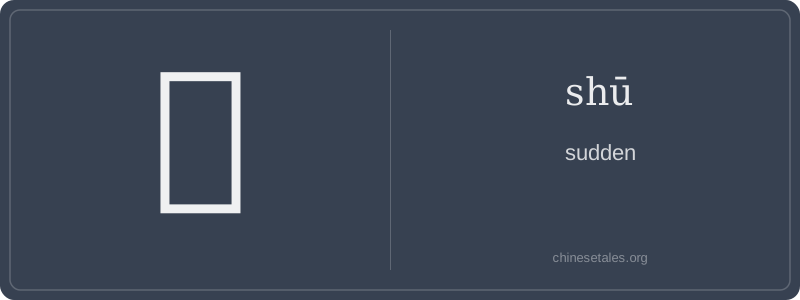
The earliest form of 倏 appears in Warring States bamboo texts — not oracle bones, but elegant ink inscriptions where the left side was 人 (later simplified to 亻), and the right side resembled a stylized ‘dog’ (犬) with three horizontal strokes above it, representing swift motion or flickering light. Over centuries, 犬 morphed into 叔 (shū, meaning ‘uncle’ — a phonetic clue), while the three dots became the modern 丶丶丶 (three ‘dots’ at top right), symbolizing rapid, scattered movement — like sparks flying. By the Han dynasty, the character stabilized into today’s 10-stroke form: 亻 + 叔, with the three dots neatly tucked above the 又 component.
This evolution mirrors its meaning shift: from depicting physical swiftness (a running figure + dog-like alertness) to abstract, instantaneous change. In the *Zhuangzi* (c. 4th century BCE), 倏 appears alongside 忽 (hū, ‘in a blink’) as mythic figures who, in their well-intentioned haste, kill Chaos by over-organizing it — cementing 倏’s association with disruptive, irreversible suddenness. Its visual rhythm — quick vertical stroke (亻), then a cascading right side — literally *looks* like something appearing and vanishing in one breath.
Think of 倏 (shū) as Chinese literature’s ‘flash-bang’ — not a loud noise, but the *instant* the flash appears and vanishes. It doesn’t describe duration; it marks the razor-thin slit between ‘not yet’ and ‘already gone’. Unlike English adverbs like ‘suddenly’, which can modify verbs freely (*He suddenly laughed*), 倏 is strictly literary, almost poetic: it only appears in written Chinese, never in casual speech or beginner textbooks — and it *must* precede the verb it modifies, often with a pause implied: 倏然 (shū rán) or 倏地 (shū dì). You’ll never hear it in a WeChat message; you *will* find it in Zhuangzi’s butterfly dream or Tang dynasty poetry when time itself blinks.
Grammatically, it’s a temporal adverb that behaves like a lightning strike — brief, autonomous, and visually arresting. It’s never used alone: always paired with 然, 地, or 忽 (as in 倏忽). Learners often mistakenly treat it like 突然 (tū rán) and try to say *shū le* — but 倏 has no *-le* form! Its pastness is baked into its very essence: if it happened, it’s already vanished. Also, it’s never used predicatively (*This is sudden* → ❌ 倏是 — no such phrase).
Culturally, 倏 carries Daoist weight — it evokes the ineffable, fleeting nature of reality. In the *Zhuangzi*, 倏 and 忽 are personified as two emperors who ‘bored seven holes’ in Chaos — a brilliant metaphor for how human cognition imposes sudden distinctions on undifferentiated wholeness. That’s why learners misusing it sound oddly philosophical… or just wrong. The biggest trap? Confusing its elegance with utility — it’s a brushstroke, not a tool.