倅
Character Story & Explanation
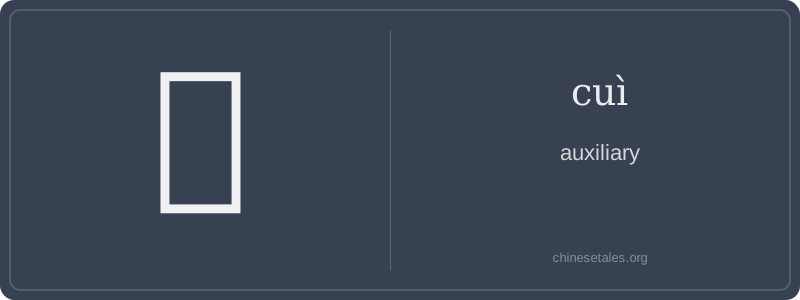
The character 倅 first appeared in late Han bronze inscriptions and early clerical script — not as a pictograph, but as a phonosemantic compound. Its left radical 亻 (rén, 'person') clearly marks it as human-related, while its right component 卒 (zú, 'soldier; finally') provides both sound (cù → cuì via tone shift and dialectal softening) and layered meaning: 卒 originally depicted a soldier completing duty, later acquiring connotations of 'completion' and 'subordinate execution'. Early forms show 亻 tightly bound to a simplified 卒 — no oracle bone version exists, as 倅 emerged centuries after that stage, born from administrative need, not natural observation.
By the Tang dynasty, 倅 was standard in official documents to denote deputy magistrates, especially in prefectural offices where the chief (刺史 cìshǐ) required a formally appointed counterpart. The Tang poet Du Fu even referenced it indirectly in a poem lamenting a friend’s demotion to a 倅 post — underscoring its association with capable yet sidelined talent. Visually, the tight fusion of 亻 and 卒 mirrors its semantic fusion: a person whose role is defined by *completing another’s charge*. No stroke is decorative — every line reinforces hierarchy and function.
Imagine a bustling Ming-dynasty magistrate’s yamen: the chief official sits at the center, but beside him — slightly lower, slightly to the side — stands his 倅 (cuì), the vice-magistrate. Not the boss, not a clerk, but the indispensable right hand: stepping in during illness, co-signing documents, handling delicate local disputes before they escalate. That’s the soul of 倅 — not just 'assistant' but *institutional second-in-command*, carrying delegated authority with quiet gravity. It’s never used for casual help ('Can you pass the salt?') or modern job titles like 'assistant manager'; it’s reserved for formal, hierarchical, often governmental or military deputy roles.
Grammatically, 倅 is almost always a noun and appears in compound terms — rarely standalone. You’ll see it in titles like 刺史倅 (cì shǐ cuì, 'vice-prefect') or 縣倅 (xiàn cuì, 'deputy county magistrate'). It never takes aspect particles (了, 过) or reduplication. Learners sometimes misread it as 'cuī' (like 推) or force it into verb slots ('He 倅s the project'), but it’s strictly a title noun — like 'lieutenant' or 'deputy', not 'to assist'.
Culturally, 倅 carries a subtle tension: it signals competence and trust, yet also subordination. In classical texts, a 倅 who oversteps is criticized; one who underperforms brings shame to his superior. Modern usage is extremely rare — mostly in historical novels, academic writing on imperial bureaucracy, or ironic, archaic-sounding bureaucratic satire. Don’t hunt for it in apps or street signs; it lives in inked scrolls and scholarly footnotes.