倃
Character Story & Explanation
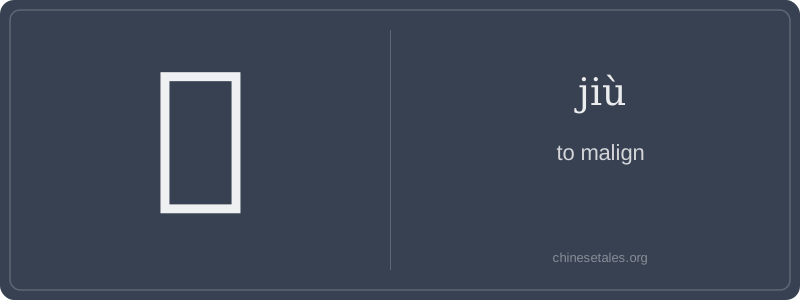
The earliest form of 倃 appears in Warring States bamboo slips — not as a pictograph, but as a phonosemantic compound: left side 亻 (person radical), right side 就 (jiù), which originally depicted a bird alighting on a nest (in oracle bone script, 就 combined 尢 + 尤 + 隹). Over centuries, the right component simplified and stylized; the ‘bird’ (隹) eroded into the top dots and crossbar, while the ‘nest’ (尤/尢) morphed into the lower ‘foot’-like structure. Crucially, the original 就 carried connotations of ‘approaching with purpose’ — so 倃 literally meant ‘a person approaching with ill intent to distort’.
This semantic nuance deepened in Han dynasty commentaries: in the *Shuōwén Jiězì*, Xu Shen defines 倃 as ‘以惡言加人也’ — ‘to impose evil words upon another’. It appears in the *Book of Rites* describing how slanderous ministers ‘倃賢以亂政’ (malign the worthy to disrupt governance). The character’s visual austerity — clean lines, no flourishes — mirrors its function: slander stripped bare of emotion, delivered with chilling efficiency. Even today, its shape feels ‘lean and pointed’, like a sharpened stylus dipped in ink — and malice.
Let’s cut through the fog: 倃 (jiù) isn’t just ‘to malign’ — it’s the quiet, deliberate act of twisting someone’s words or reputation with precision, like a craftsman carving slander into jade. It carries moral weight and literary gravity; you won’t hear it in casual chat or WeChat messages. It’s a classical verb that implies intentionality, often with an air of hypocrisy or concealed malice — think of a court official whispering half-truths to undermine a rival. Unlike generic verbs like 诽谤 (fěibàng), which is broad 'defamation', 倃 suggests calculated distortion, almost ritualistic in its severity.
Grammatically, 倃 is transitive and almost always appears in formal or literary contexts — never alone in speech. You’ll see it in structures like ‘倃…以…’ (‘malign X in order to…’) or passive constructions like ‘为…所倃’ (‘be maligned by…’). Learners often mistakenly use it as a standalone verb like ‘he slandered me’, but native usage demands context: a motive, a target, and usually a classical syntactic frame. Also, it’s never used with modern pronouns like 我 or 你 as subject in spoken Chinese — it’s reserved for historical narratives or rhetorical writing.
Culturally, 倃 echoes Confucian anxieties about speech ethics — the *Analects* warns against ‘巧言令色’ (deceptive speech), and 倃 is the lexical embodiment of that danger. A common mistake? Confusing it with 舊 (jiù, ‘old’) due to identical pronunciation — but they’re etymologically unrelated and visually worlds apart. Using 倃 where you mean 舊 will make your sentence sound like ‘I malign this book’ instead of ‘this old book’. Yikes.