俷
Character Story & Explanation
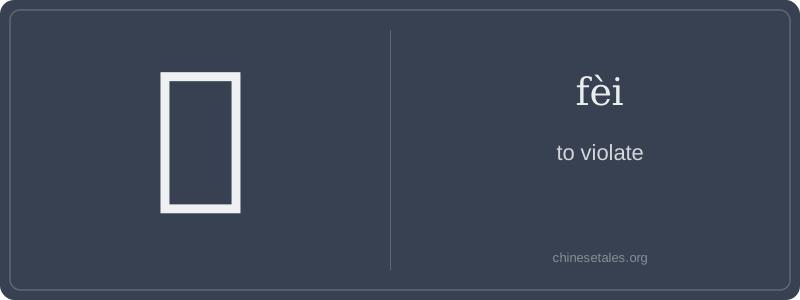
The earliest form of 俷 appears in Warring States bamboo slips as a compound ideograph: left side 亻 (person radical), right side 匹 — but not the modern 'piece' character. In bronze script, 匹 was a stylized depiction of two folded silks bound together, symbolizing *binding agreement*. Over centuries, the right-hand component simplified and merged visually with 尸 (a corpse/ritual posture), creating the illusion of 'a person lying across a sacred boundary' — reinforcing the idea of deliberate, disrespectful crossing.
This visual evolution mirrors its semantic journey: from concrete 'untying a binding' in Zhou dynasty ritual manuals to abstract 'violating covenant' in Mencius (《孟子·离娄上》: '不俷仁,不违义'), where it appears alongside 仁 (benevolence) and 义 (righteousness) as moral absolutes. By the Han dynasty, 俷 became synonymous with rebellion against normative order — not just law, but the unspoken harmony of human relationships. Its rarity today isn’t decline, but preservation: like a ceremonial dagger kept in its scabbard, drawn only when the integrity of principle itself is at stake.
Think of 俷 (fèi) as the Chinese linguistic equivalent of a red 'DO NOT CROSS' tape — not just 'breaking' something, but deliberately flouting a sacred boundary, like a judge ignoring precedent or a scholar rejecting classical rites. It carries moral weight, implying betrayal of trust or duty, not mere physical violation. You’ll almost never hear it in casual speech; it’s reserved for formal, literary, or historical contexts — much like English words such as 'transgress', 'violate', or 'breach' when used in legal or ethical declarations.
Grammatically, 俷 is almost always a verb and appears in compound verbs (e.g., 俷礼, 俷约), rarely standalone. It never takes aspect particles like 了 or 过 directly — instead, you’d say '俷反了礼制' (fèi fǎn le lǐ zhì), where 俷 modifies the action, not the tense. Learners often misread it as 'fēi' (like 非) or mistakenly pair it with modern colloquial nouns ('俷规矩'), which sounds jarringly archaic — like saying 'hath transgressed thy rules' at a team meeting.
Culturally, 俷 echoes Confucian hierarchy: to 俷 is to destabilize the cosmic-social order. In classical texts, it’s tied to rulers who defy Heaven’s Mandate or ministers who undermine ritual propriety. Modern usage is nearly extinct outside academic writing or historical dramas — making it a 'fossil character': grammatically precise, semantically potent, and utterly impractical for daily life. That’s why it’s absent from HSK — it’s not that it’s hard, but that it’s *rarely needed*.