俶
Character Story & Explanation
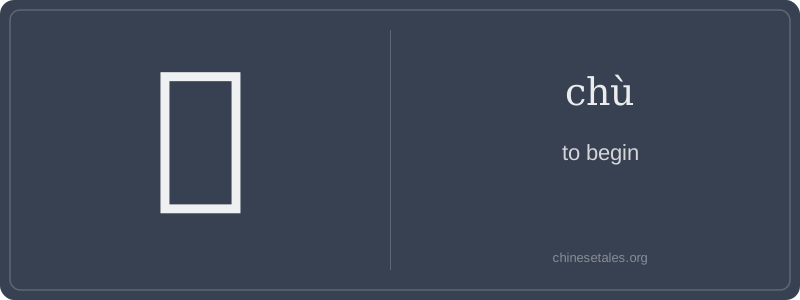
The earliest form of 俶 appears on Warring States bamboo slips as a compound ideograph: left side 亻 (person radical), right side 叔 — not merely 'uncle', but an ancient phonetic component with deep roots in ritual timing. The bronze script version shows a standing figure beside a stylized 'grain stalk + hand' motif, symbolizing the first act of sowing — not just planting, but the ceremonial commencement of the agricultural year. Over centuries, the right-hand element simplified from 叔’s full form (with 竹 + 專) to today’s streamlined 叔-like shape, while the person radical solidified as 亻, preserving the human agent at the heart of initiation.
This visual logic shaped its meaning: 俶 wasn’t just 'to start' — it was 'to begin rightly'. Confucius’s disciples used it in the Book of Rites to describe the Duke of Zhou’s first enactment of ritual propriety (‘俶行礼’), and Sima Qian invoked it in the Records of the Grand Historian when chronicling the founding of dynasties. Its shape — a person beside a symbol of timed action — became a linguistic seal of legitimacy: only actions aligned with virtue and season could truly be 俶.
At its heart, 俶 (chù) carries the quiet gravity of a first step — not the flashy 'beginning' of a startup pitch, but the solemn, almost sacred initiation found in classical texts: the dawn of virtue, the start of a ritual, the moment heaven’s mandate first stirs in a sage. It’s not everyday speech; you won’t hear it in subway announcements or WeChat chats. Instead, it breathes in poetic lines and historical inscriptions, evoking intentionality and auspicious origin — think less 'let’s get started!' and more 'thus began the Way of the King.'
Grammatically, 俶 is almost always verb-initial and highly literary. It rarely stands alone — you’ll see it paired with nouns like 俶载 (chù zǎi, 'to begin cultivation') or 俶辰 (chù chén, 'auspicious beginning hour'). It never takes aspect markers like 了 or 过, and doesn’t combine with modern verbal complements (e.g., *俶完, *俶起来). Learners who force it into colloquial syntax often sound like they’re quoting a bronze inscription at a coffee shop — charming, but confusing.
Culturally, 俶 reveals how deeply Chinese thought links 'beginning' with moral readiness and cosmic alignment. Unlike English ‘begin’, which is neutral and procedural, 俶 implies that the start must be ritually proper, ethically grounded, and cosmologically timely. A common mistake? Assuming it’s interchangeable with 开始 (kāishǐ) or 起 (qǐ) — but using 俶 in casual speech doesn’t just sound archaic; it subtly suggests you’re invoking ancestral rites to order takeout.