俴
Character Story & Explanation
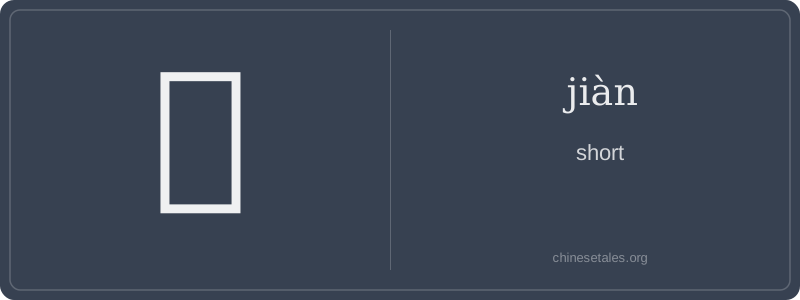
The earliest form of 俴 appears on Warring States bamboo slips — not oracle bones — and it’s a brilliant stroke of semantic engineering. Its left side is the 'person' radical (亻), while the right is 戔 (jiān), which originally depicted two halberds (戈) facing each other, symbolizing 'smallness through containment' or 'repeated cutting down'. Over centuries, the halberds simplified into the stacked '戋' shape we see today — a visual metaphor for something deliberately reduced, trimmed, or restrained.
This dual imagery — person + reduction — crystallized into 'a person wearing shortened attire', especially ritual garments cut precisely for humility or function. The Zuo Zhuan (c. 4th c. BCE) uses 俴 in descriptions of ministers’ robes during rites of submission, where excess fabric implied arrogance. Later, scholars extended the meaning to 'concise speech' or 'modest conduct'. Crucially, its form never drifted — unlike many characters, 俴 kept its original structure intact for over 2,300 years, making it a fossil of early Chinese semiotics.
Let’s be honest: 俴 (jiàn) is a rare bird — it means 'short' but you’ll almost never hear it in daily conversation. It’s not the friendly, everyday 短 (duǎn); 俴 is literary, archaic, and carries a subtle, almost poetic weight — like describing the brevity of life, the conciseness of a classical essay, or the modest length of a ceremonial robe. Think 'elegant shortness', not 'my phone battery is short'.
Grammatically, 俴 functions as an adjective — but only in formal, written contexts, often paired with nouns like 文 (wén, writing), 衣 (yī, garment), or 身 (shēn, body). You won’t say 'this pencil is 俴'; instead, you might read in a pre-Qin text: '俴衣' (jiàn yī) — 'a short ceremonial tunic'. It never stands alone like 短 does; it’s always part of a compound or modifier phrase, and it *never* takes degree adverbs like 很 or 非常. That’s a classic learner trap: inserting 'hěn' before 俴 sounds jarringly wrong to native ears.
Culturally, 俴 reflects ancient ritual precision: clothing length signaled rank and propriety, so 'short' wasn’t just physical — it was ethically calibrated. Modern learners stumble by overgeneralizing from 短, but 俴 isn’t a synonym — it’s a time capsule. Use it in essays about classical aesthetics or historical costume, and you’ll impress your teacher. Skip it for ordering food or complaining about Wi-Fi.