伣
Character Story & Explanation
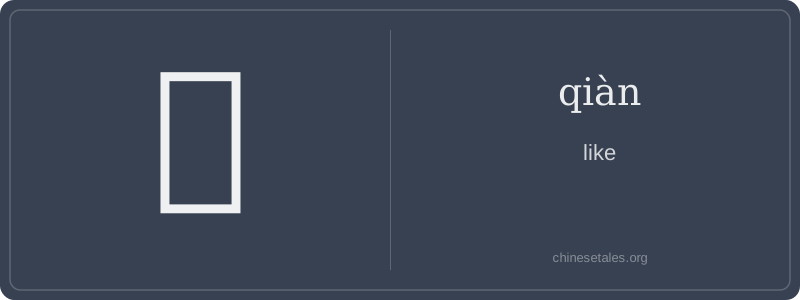
The earliest form of 伣 appears in Warring States bamboo slips — not as a pictograph, but as a phonosemantic compound: the left side '亻' (person radical) anchors human agency, while the right side '见' (jiàn, 'to see') was originally borrowed for sound, not meaning. Crucially, '见' here wasn’t chosen for vision — its ancient pronunciation *kʰen-s* closely matched the desired word for 'likeness', making this one of early Chinese’s most elegant phonetic loans. Over time, clerical script simplified the '见' component, dropping the inner '目' (eye) stroke, leaving just the skeletal outline we see today.
This character didn’t evolve from 'seeing' but from *sounding like* 'seeing' — a linguistic sleight-of-hand. In the Book of Rites, it appears in '伣天之明' ('as if embodying heaven’s clarity'), linking moral virtue to cosmic order. The visual minimalism — just two strokes added to '人' — mirrors its semantic role: a subtle grammatical hinge, not a heavy lexical door. Confucian scribes prized it precisely because it implied comparison without equating — honoring hierarchy by preserving distance between subject and simile.
Think of 伣 as Chinese poetry’s quiet whisper of comparison — not the blunt 'like' of English similes, but a refined, almost ceremonial 'as if' that hovers between metaphor and reverence. It doesn’t shout 'similar'; it bows slightly, like a scholar gesturing toward a classical allusion. You’ll rarely hear it in daily speech — it lives in literary texts, historical commentaries, and formal writing where nuance matters more than speed.
Grammatically, 伣 functions as an adverbial particle (not a verb or conjunction), typically placed before a noun or clause to mean 'as if', 'as though', or 'like' in a figurative, elevated sense. For example: '伣天之威' (qiàn tiān zhī wēi) — 'as if possessing heaven’s awe'. Note: it never takes objects or verbs directly; unlike 'xiàng' (像), it can’t say 'xiàng tā' (like him) — 伣 stands alone, modifying entire phrases with quiet gravity.
Learners often mistakenly treat it as a synonym for 像 or 如, leading to jarring, unnatural sentences. Worse: because it’s absent from HSK and modern textbooks, many assume it’s obsolete — but it appears regularly in prefaces to classical reprints, academic essays on Daoism, and even modern poets channeling Tang dynasty diction. Its rarity is its power: using 伣 signals deliberate stylistic choice, not vocabulary gap.