俑
Character Story & Explanation
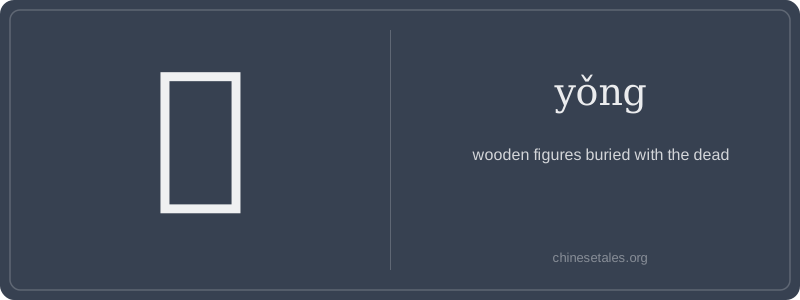
The earliest form of 俑 appears in Warring States bamboo texts, not oracle bones — and it’s a masterclass in semantic shorthand. Its left side 亻 (rén, ‘person’) anchors the human element, while the right side is a simplified version of 甬 (yǒng), which originally depicted a bell-shaped vessel on a stand — but phonetically lent its sound *and* subtly evoked hollow, cast forms. Over centuries, the right-hand component stabilized into 用 (yòng), though it’s *not* the character 用 — it’s a distinct, archaic variant that retained the original pronunciation and funerary connotation. Every stroke tells a story: two dots for eyes staring into eternity, a vertical line for the body, and the lower part suggesting containment — like a figure sealed in a tomb.
By the Qin and Han dynasties, 俑 exploded in use — thousands were buried with elites, from warriors and musicians to acrobats and servants. The character itself became a cultural litmus test: its presence in texts signaled elite burial practice, ritual propriety, or philosophical debate. Mencius later echoed Confucius’ critique, cementing 俑 as both archaeological artifact and ethical symbol. Visually, its clean 9-stroke structure hides layers of history — every curve and angle echoes the kiln, the chisel, and the quiet reverence of ancestors who believed clay could breathe in the dark.
At its heart, 俑 (yǒng) is a quiet ghost of ancient China — not spooky, but solemn and sculpted. It refers specifically to funerary figurines: life-sized or miniature clay, wood, or bronze figures buried alongside nobles and emperors to serve them in the afterlife. Think Terracotta Army — those iconic warriors? Each one is a 俑. The character feels weighty and ritualistic; it’s never used for modern statues, toys, or decorative dolls — only for objects made *for burial*. Using it casually (e.g., calling a garden gnome a 俑) would sound bizarre, even disrespectful.
Grammatically, 俑 functions as a noun and almost always appears in compound words or historical contexts — you’ll rarely see it solo in speech. It’s often modified by material (tǔ yǒng, ‘earthen 俑’) or function (shì cóng yǒng, ‘attendant 俑’). Learners sometimes misread it as yōng (like 拥), but the tone is second — yǒng — and the meaning is strictly funerary. No verbs, no adjectives, no metaphors: this word stays in the tomb.
Culturally, 俑 carries moral gravity. Confucius famously condemned early human sacrifices — then praised the shift to figurines as a humane evolution: ‘始作俑者,其无后乎!’ (‘The first person to make 俑 — may he have no descendants!’). Yes — he criticized the *invention* of 俑 as a slippery slope toward dehumanization! That paradox — honoring life by replacing death with clay — still echoes in how scholars read this character today.