侂
Character Story & Explanation
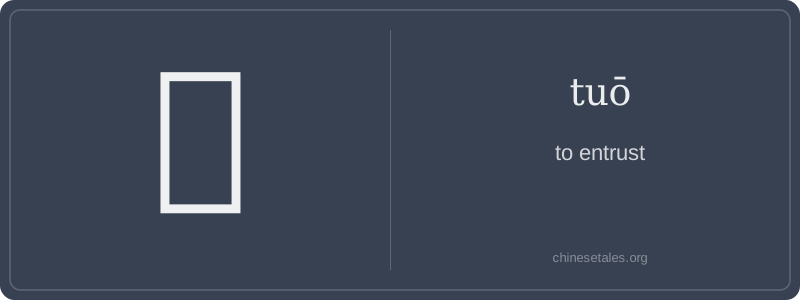
The earliest form of 侂 appears in Warring States bamboo slips as a compound ideograph: left side 亻 (person radical), right side 咄 — itself a phonetic component derived from an ancient pictograph of a mouth (口) beside a stick-like stroke (丿), representing forceful utterance or command. Over centuries, the right side simplified: 咄 lost its full mouth shape, its dot became a dot above the horizontal stroke, and the lower ‘dog’ (犭) or ‘hand’ (又) elements vanished entirely, leaving today’s stylized 口+一+丶+丿 structure. Visually, it’s a person (亻) standing beside a spoken mandate — literally 'a person entrusted by authoritative speech.'
This visual logic anchored its meaning: in the *Zuo Zhuan*, 侂 appears in contexts where rulers formally invest ministers with military command — '侂以三军之政' ('entrusted him with governance of the three armies'). Unlike 托 (which evolved from 'supporting with hands'), 侂 never meant physical lifting; it always implied *verbal, binding delegation*. Its rarity in modern usage reflects how profoundly China’s bureaucratic culture shifted: where once entrustment required ritual speech and ancestral sanction, today’s delegation flows through emails and job titles — leaving 侂 as a fossil of performative, ceremonial authority.
Think of 侂 (tuō) as the Chinese equivalent of handing someone a sealed, wax-stamped letter in a Victorian courtroom — not just 'giving,' but *formally delegating authority* with solemn weight. It’s not casual ('I’ll pass you the salt') or transactional ('I sold you the bike'); it’s deeply relational and hierarchical: entrusting responsibility, office, or sacred duty — often from elder to junior, ruler to minister, or master to disciple. You’ll almost never hear it in daily speech; it lives in classical texts, historical dramas, and formal political rhetoric.
Grammatically, 侂 is almost always a verb followed by a noun denoting the entrusted thing — typically an office (e.g., 侂以重任), a mission (侂以使命), or authority (侂以大权). It doesn’t take objects with 的 or 把, nor does it appear in simple SVO sentences like 'I entrusted him.' Instead, it appears in elegant, parallel constructions: '上侂以社稷之重,下寄以黎庶之望' ('The sovereign entrusted him with the weight of the state; the people placed upon him the hopes of the common folk'). Learners mistakenly try to substitute it for 交 (jiāo, 'to hand over') or 托 (tuō, 'to ask/take care of') — but 侂 carries none of their informality or reciprocity.
Culturally, 侂 evokes Confucian ideals of righteous delegation: trust isn’t earned through competence alone, but through moral integrity and ancestral legitimacy. A classic blunder? Using 侂 when you mean 托 — saying '我侂他帮我' sounds like you’re appointing your friend as imperial regent, not asking him to water your plants. That’s why it’s absent from HSK: it’s not about frequency, but about precision — a character that only breathes in the rarefied air of historical gravity.