侁
Character Story & Explanation
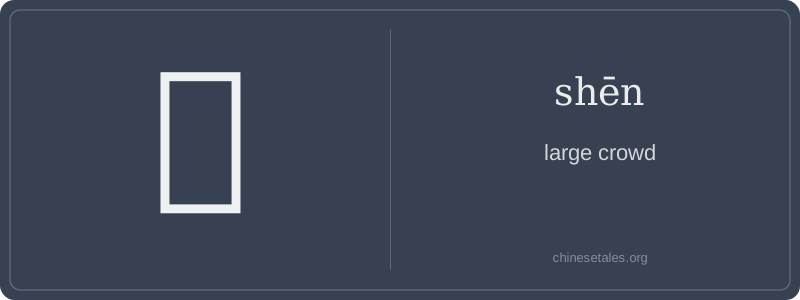
The earliest form of 侁 appears in late Warring States bamboo slips and Han dynasty seals as a compound ideograph: on the left, 亻 (rén bàng, 'person radical'), and on the right, 先 (xiān, 'first, prior'). Crucially, 先 itself was originally a pictograph showing a foot (止) stepping ahead of a person (儿) — symbolizing precedence and movement. In 侁, this wasn’t about 'first person,' but about *many persons moving forward together*, like a vanguard swelling into a tide. Over centuries, the right-hand component simplified from full 先 to its modern form, while the left retained its human essence — no strokes were added or lost; every line serves the idea of collective motion.
By the Tang dynasty, 侁 had crystallized into its current meaning through poetic usage: Du Fu described refugee columns as '侁侁行旅' (shēn shēn xíng lǚ), where reduplication amplified the image of endless, weary procession. The Shuōwén Jiězì (c. 100 CE) glossed it as '眾也' (zhòng yě, 'a multitude'), confirming its semantic core lay not in hierarchy or origin, but in scale and synchrony. Visually, the two components lean into each other — 亻 slightly tilted, 先 upright yet leaning — mirroring how crowds press forward: unified, urgent, inseparable.
侁 (shēn) is a rare, literary character meaning 'a large crowd' — not just any group, but one dense, bustling, almost overwhelming in its sheer number and movement. Think of the packed aisles of a temple fair during Lunar New Year, or pilgrims surging up Mount Tai at dawn: it’s visceral, collective energy made visible. Unlike common synonyms like 人山人海 (rén shān rén hǎi, 'people mountains, people seas'), 侁 carries classical weight and poetic compression — you’ll almost never hear it in speech, only in historical texts, poetry, or highly stylized prose.
Grammatically, 侁 functions as a noun or attributive noun, often paired with measure words like 群 (qún) or used adjectivally before nouns (e.g., 侁众). It rarely stands alone; instead, it appears in compounds like 侁侁 (shēn shēn), where reduplication intensifies the sense of massed humanity. Learners shouldn’t try to insert it into everyday sentences — doing so sounds archaic or even comically solemn, like saying 'thou art' at a coffee shop. Its usage is tightly bound to rhythm, parallelism, and classical register.
Culturally, 侁 evokes pre-Qin and Han-era depictions of ritual gatherings, military musters, or imperial processions — moments when population density signaled power, piety, or cosmic alignment. A common mistake is misreading it as 仙 (xiān, 'immortal') due to visual similarity in cursive script, or confusing it with 伸 (shēn, 'to stretch') because of identical pronunciation — but their meanings and etymologies are worlds apart. This character doesn’t describe individuals; it erases them into a living, breathing mass.