侀
Character Story & Explanation
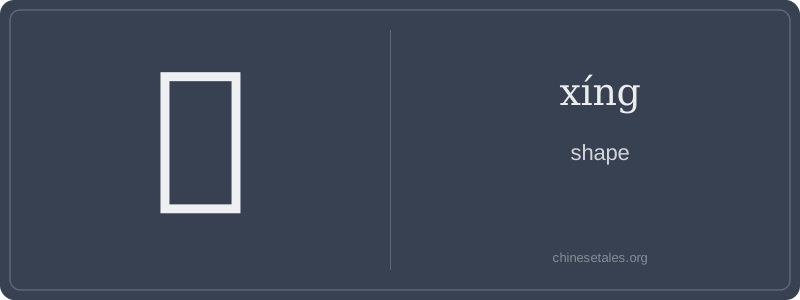
The earliest known form of 侀 appears on Warring States bamboo slips — not oracle bones — and it’s a deliberate fusion: left side 亻 (person radical), right side 刑 (xíng, 'punishment; mold'). This wasn’t a pictograph of a physical shape, but a conceptual compound: 'human + mold/punishment'. The 刑 component originally depicted a tool for casting bronze vessels — a literal mold — and later extended to 'standardized form' and 'penal code' (as laws are molds for behavior). Over time, the right side simplified from 刑 to a stylized, compact form retaining its top 刂 (knife) and bottom 开-like base — hence today’s 侀, which looks deceptively simple but hides layered history.
This character crystallized during the Han dynasty as scholars sought precise terms for metaphysical categories. In the Shuōwén Jiězì (121 CE), Xu Shen defines 侀 as 'the fixed pattern established by Heaven and Earth' — linking form to cosmic order. It appears in rare but potent contexts: Zhu Xi’s commentaries contrast 侀 (Heaven-ordained form) with 形 (mutable, perceptible shape). Visually, the person radical (亻) anchors the idea in human society — 侀 isn’t abstract geometry; it’s the shape *we must inhabit* — in ritual, law, and ethics. Its rarity today reflects how modern Chinese prioritizes dynamic, observable reality over static cosmic blueprints.
Let’s be honest: you’ll almost never see 侀 in modern Chinese — and that’s precisely what makes it fascinating. Its core meaning is 'shape' or 'form', but not the everyday kind (that’s 形, xíng). 侀 is archaic, philosophical, and deeply tied to classical concepts of fixed, unchangeable structure — like the 'mold' that gives something its essential, immutable nature. Think Confucian rites or Daoist cosmology: once a thing has its 侀, it’s set in cosmic order. It carries weight, solemnity, and a hint of inevitability.
Grammatically, 侀 functions as a noun and appears almost exclusively in classical compounds or literary allusions — never alone in speech or casual writing. You won’t say 'this apple has a 侀'; you might read in a Song dynasty essay: '禮之有侀,猶水之有岸' (Ritual has its fixed form, just as water has its banks). Note how it pairs with abstract nouns (禮, 天, 道) — never concrete objects. Learners mistakenly treat it like 形 and try to use it adjectivally ('shaped like…'), but 侀 resists that. It’s about ontological grounding, not visual contour.
Culturally, 侀 reveals how Chinese thought historically distinguished between surface appearance (形) and essential, normative structure (侀). It’s the difference between 'what something looks like' and 'what it fundamentally *is*, by cosmic or moral design'. A common mistake? Assuming it’s interchangeable with 形 — but swapping them turns a profound philosophical statement into nonsense. Also, don’t confuse its pronunciation: it’s xíng (second tone), *not* xìng — that’s a different character entirely (like 性, 'nature').