佺
Character Story & Explanation
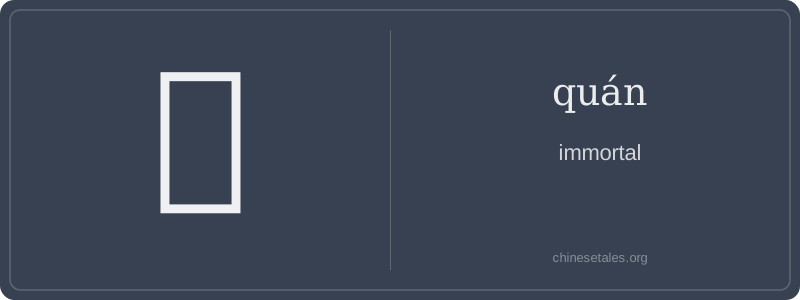
The character 佺 first appeared in early seal script (around 3rd century BCE), derived from the radical 亻 (person) combined with 全 (quán, ‘complete, intact’). Visually, it was a stylized human figure standing beside a balanced, symmetrical glyph representing wholeness — suggesting a person who has achieved perfect physical and spiritual integrity. Over centuries, the left-side 亻 simplified from a full walking man to two strokes, while the right-side 全 evolved from a depiction of a covered vessel (indicating completeness) into its modern form: a lid () atop a ‘king’ (王) — symbolizing sovereign mastery over life and death.
This visual logic directly shaped its meaning: in the *Zhuangzi* and Han dynasty texts, 佺 referred specifically to legendary sages like Wang Quan (王佺), said to have lived 500 years by drinking dew and breathing cosmic qi. By the Tang dynasty, poets like Li He used 佺 to evoke ethereal, untouchable beings — not gods, but perfected humans who’d transcended decay. The character’s structure itself became a mnemonic: only when person (亻) and wholeness (全) unite does true immortality arise — a philosophical equation carved in ink.
Think of 佺 (quán) as China’s answer to the Greek ‘hero-god’ — not quite a deity, not quite mortal, but someone who’s cheated death through cultivation, virtue, or divine favor. In Chinese, it carries a distinctly Daoist flavor: serene, ageless, floating above worldly concerns like a cloud over Mount Kunlun. Unlike English ‘immortal’, which often implies eternal life by default (e.g., ‘immortal soul’), 佺 always evokes *active transcendence* — think alchemy, qigong, and peach banquets on celestial peaks.
Grammatically, 佺 is almost never used alone in modern speech — you won’t hear someone say ‘He is 佺’. Instead, it appears almost exclusively in literary compounds (like 佺仙 or 王佺), classical poetry, or personal names (especially historical or mythological figures). It functions like a poetic title or honorific noun, not an adjective — so don’t try to say *quán de rén* (‘immortal person’) — that construction feels unnatural and archaic. Learners sometimes misread it as quán (‘whole’) due to identical pinyin, but the meanings are worlds apart: one is metaphysical, the other is mathematical.
Culturally, 佺 is a quiet icon of Daoist aspiration — not about power or glory, but effortless longevity and harmony with the Dao. Mistake it for common words like 全 or 泉, and you’ll accidentally turn your immortal sage into ‘a whole spring’. Its rarity outside classical texts means it’s mostly encountered in Tang poetry, Ming novels, or as a rare given name — making it a delightful ‘deep cut’ for learners ready to peek behind the curtain of everyday Mandarin.