佹
Character Story & Explanation
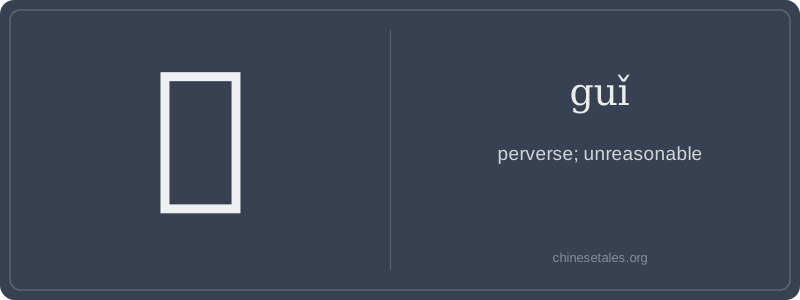
The character 佹 first appeared in seal script during the Warring States period — not as a pictograph, but as a carefully constructed semantic-phonetic compound. Its left side, 亻 (rén bàng), is the ‘person’ radical, anchoring it in human behavior. Its right side, 圭 (guī), is both phonetic (sharing the guǐ sound) and symbolic: 圭 was a jade tablet used in ancient rituals to mediate between heaven and earth — representing correctness, authority, and alignment. So visually, 佹 literally juxtaposes ‘person’ with ‘ritual jade,’ implying a person who *holds up the wrong tablet*: one who perverts sacred standards.
Over time, its meaning sharpened from general ‘deviation’ to morally charged ‘perversity.’ In the Zhuangzi, 佹 is used to describe arguments that twist logic until truth becomes unrecognizable — ‘佹辭’ (guǐ cí, ‘perverse speech’) appears in Chapter 33 as a warning against sophistry that mimics wisdom. The character’s visual tension — the upright 亻 beside the rigid, angular 圭 — mirrors its semantic tension: a human figure standing *correctly*, yet embodying *wrongness*. That paradox is baked into every stroke.
‘佹’ (guǐ) isn’t just ‘perverse’ — it’s the linguistic equivalent of a raised eyebrow and a sigh: a quiet, almost literary recoil at something that *should* make sense but stubbornly doesn’t. It carries moral weight and intellectual discomfort — not mere oddity, but a violation of natural or ethical order. You won’t hear it in daily chatter; it appears in classical essays, philosophical critiques, or sharp literary commentary where someone calls out twisted logic, hypocritical conduct, or a worldview turned inside-out.
Grammatically, 佹 is almost always adjectival and tightly bound to nouns like ‘道’ (dào, 'principle'), ‘論’ (lùn, 'argument'), or ‘行’ (xíng, 'conduct'). It rarely stands alone — you’ll see 佹道 (guǐ dào), not *佹* + verb. Learners often misread it as a synonym for 奇 (qí, 'strange') or 怪 (guài, 'weird'), but those lack 佹’s moral judgment: 奇 is neutral curiosity; 怪 can be playful or alarming; 佹 is *disapproving*. Think of it as ‘perverse’ in the Kantian sense — not evil, but fundamentally misaligned with reason or virtue.
Culturally, 佹 reflects a deep Chinese value: harmony (hé) as an ontological norm. When something is 佹, it’s not just different — it’s *out-of-tune* with the Dao, Heaven’s pattern, or human decency. A common mistake? Using it in casual speech (e.g., *‘This coffee tastes 佹!’*) — no native speaker would do that. It belongs in essays on corrupted bureaucracy or translations of Zhuangzi’s paradoxes, not WeChat messages.