佸
Character Story & Explanation
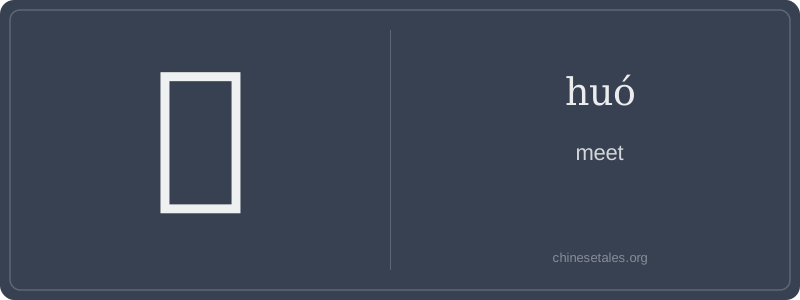
The earliest form of 佸 appears in Western Zhou bronze inscriptions as a composite pictograph: a person (亻) standing beside a phonetic component that resembled a stylized 'mouth' or 'vessel' (活’s ancient variant), suggesting vocal acknowledgment upon meeting. Over centuries, the right side simplified from a complex vessel + water glyph into the modern 活 — not because it means 'alive', but because it served as a *sound loan* (xiéshēng): same pronunciation, different meaning. The left radical 亻 (person) remained constant, anchoring the human dimension of encounter.
This character blossomed in the Shījīng, particularly in Ode 247 ('Fángfēng'), where 宴佸 describes the harmonious gathering of kin after separation. Unlike generic 会, 佸 always implies reciprocity and emotional warmth — like two hands clasping, not two schedules aligning. Its visual evolution mirrors its semantic journey: from concrete depiction of face-to-face recognition → phonetic borrowing → crystallization into a literary marker of meaningful reunion. Even today, calligraphers savor its balanced structure — the upright 亻 leaning gently toward the flowing 活, as if stepping forward to greet.
Let’s be honest: 佸 (huó) is a ghost character — elegant, ancient, and nearly extinct in modern speech. Its core meaning is 'to meet' or 'to reunite', but it carries a deeply poetic, almost ritualistic weight, like two travelers recognizing each other across a misty riverbank. You won’t hear it in daily conversation; instead, it lives in classical poetry, wedding odes, and solemn inscriptions where 'meeting' isn’t casual — it’s fated, harmonious, and emotionally resonant.
Grammatically, 佸 functions as a verb, often appearing in parallel structures (e.g., '佸佸' for emphasis) or paired with characters like 宴 (banquet) or 好 (harmony). It rarely stands alone in modern usage — you’ll see it in compounds like 宴佸 (yàn huó), meaning 'a joyful reunion banquet'. Learners sometimes misread it as huò or hú due to its unfamiliar tone, or confuse it with the much more common 会 (huì, 'to meet'), but 佸 implies emotional resonance and mutual recognition — not just physical presence.
Culturally, 佸 appears prominently in the Shījīng (Book of Odes), especially in wedding hymns where it evokes the auspicious coming-together of spouses. A classic mistake is forcing 佸 into contemporary sentences like 'I’ll meet you at noon' — that’s strictly 会 or 见. Using 佸 there would sound like quoting a bronze-age oracle — beautiful, but wildly out of place. Its power lies in restraint: it’s not a tool for logistics, but for lyricism.