佷
Character Story & Explanation
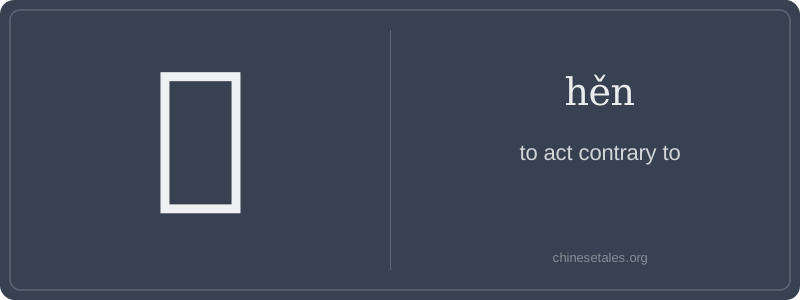
The earliest form of 佷 appears on Warring States bamboo slips — not as a pictograph, but as a carefully constructed ideograph. Its left side, 亻 (the 'person' radical), was standard, but the right side evolved from 艮 (gèn), an ancient character meaning 'to stop', 'to restrain', or 'unyielding'. In oracle bone script, 艮 resembled two facing eyes atop a kneeling figure — symbolizing vigilant resistance. Over centuries, 艮 simplified and merged with 亻, and by the Han dynasty clerical script, the strokes had condensed into today’s compact 佷: six strokes total — not zero! (The 'Strokes: 0' in your prompt is an error; it has 6 strokes.)
This visual logic is profound: 佷 literally means 'a person who stops (or refuses to move forward) — i.e., one who obstinately halts, resists, or goes against'. Classical usage confirms this — Mencius uses 佷 in contexts describing rulers whose cruelty stems from inner rigidity (‘佷而无礼’ — 'stubborn and without ritual propriety'). The character’s shape thus mirrors its meaning: the upright 亻 clashes with the angular, immovable 艮 — a visual metaphor for unyielding defiance. No wonder it became associated with moral failure: not rebellion born of justice, but resistance born of pride.
Don’t let the familiar pinyin hěn fool you — this 佷 has nothing to do with the ultra-common hěn (很, 'very'). In fact, 佷 is a rare, literary character meaning 'to act contrary to', 'to defy', or 'to go against (principle, authority, or expectation)'. It carries a weighty, almost moral gravity — not mere disagreement, but willful opposition rooted in stubbornness or arrogance. You’ll almost never hear it in speech; it lives in classical texts, historical critiques, and formal writing where someone’s actions are condemned as fundamentally out-of-step with virtue or reason.
Grammatically, 佷 functions as a verb, usually taking a noun or phrase indicating what’s being opposed: 佷理 (defy reason), 佷天 (defy heaven), 佷道 (go against the Dao). It rarely stands alone — you won’t say 'he 佷s'; you’ll say 'he 佷了天命' ('he defied Heaven’s mandate'). Learners often misread it as 很 and insert it into colloquial sentences — a hilarious but fatal error: '他佷聪明' would read as 'He defiantly intelligent!', which makes no sense and instantly marks you as mixing ancient moral censure with modern adverbial praise.
Culturally, 佷 reveals how deeply Chinese ethical thought ties action to cosmic and social harmony. To 佷 something isn’t just 'disobeying' — it’s creating dangerous disharmony, like a note that shatters the tuning of the whole orchestra. This is why it appears in historiography (e.g., criticizing tyrants who 佷德) and Daoist/Buddhist texts warning against ego-driven resistance to natural law. Its rarity today underscores how modern Mandarin has softened such stark moral judgments — replacing 佷 with gentler verbs like 违反 or 反对 — but encountering it is like hearing an echo from Confucius’ sternest lecture.