佶
Character Story & Explanation
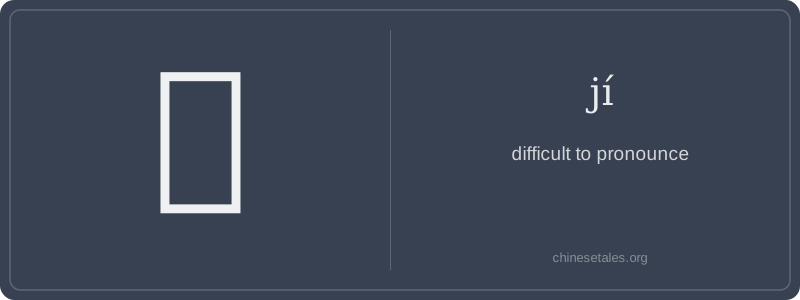
The earliest form of 佶 appears in seal script, where it clearly combines the radical 亻(person) with 吉 (jí, 'auspicious') — but crucially, the 吉 component was written with a slightly elongated, angular top stroke, evoking tension in the mouth or throat. In bronze inscriptions, the left side wasn’t yet standardized as 亻 but resembled a kneeling figure gesturing toward the mouth — a visual metaphor for vocal effort. Over centuries, the right side simplified into modern 吉, while the left solidified as the person radical, reinforcing that this difficulty is *human*-centered, not abstract.
Originally, 佶 didn’t mean 'hard to pronounce' at all — in early Zhou texts, it carried connotations of 'sturdy', 'upright', even 'majestic', describing noble bearing. But by the Han dynasty, critics began using 佶屈 (jí qū) metaphorically: just as a tall, rigid posture can make movement awkward, so too can overly formal diction twist natural speech into something strained and unnatural. The shift reflects classical China’s deep awareness of how language shape — and constrains — thought.
Think of 佶 like the 'tongue-twister' character of Chinese — not because it’s commonly used, but because its very definition is linguistic friction. Its core meaning isn’t just 'hard to pronounce', but specifically 'awkwardly articulated, stilted, or labored in speech' — like trying to say 'rural library' three times fast in English. It carries a subtle tone of artificiality or forced elegance, almost like a bureaucrat reading from a stiff script.
Grammatically, 佶 is almost never used alone; it’s strictly a literary modifier, always paired with another character (most often in the compound 佶屈 — jí qū) to describe convoluted syntax or ornate, hard-to-parse classical phrasing. You’ll see it in critiques of dense philosophical texts or overly florid poetry — never in daily chat or textbooks. Learners sometimes mistakenly treat it as a verb ('to be difficult to pronounce'), but it functions only as an adjective within fixed compounds.
Culturally, 佶 is a quiet relic of classical literary criticism — a lexical scalpel used by Ming-Qing scholars to dissect stylistic excess. Modern native speakers rarely encounter it outside academic commentary or historical novels. A common mistake is overpronouncing it as 'jié' (like 结) due to visual similarity with 吉 — but no: it’s firmly jí, with that sharp, clipped first tone, mirroring the abrupt, staccato feel it describes.