佴
Character Story & Explanation
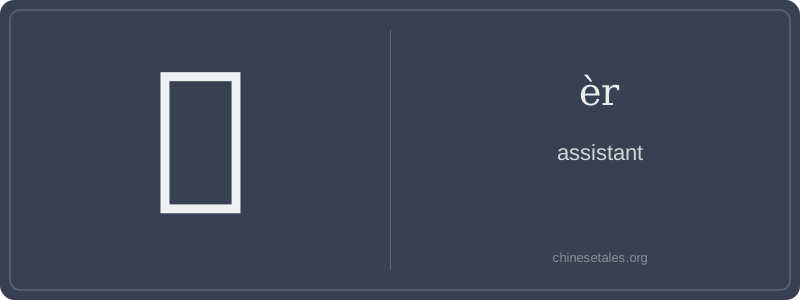
The earliest form of 佴 appears in bronze inscriptions from the late Zhou dynasty — not as a standalone pictograph, but as part of compound glyphs denoting official roles. Its structure reveals its essence: left side 亻 (the 'person' radical) anchors it as human-related, while the right side 尔 (ěr) originally depicted a tasseled ceremonial banner or ornamental streamer — symbolizing status, assignment, and visible designation. Over centuries, 尔 simplified from a complex banner-and-ribbons shape into today’s six-stroke form, while 亻 remained stable. The eight strokes we write now — two for the person radical, six for 尔 — encode this ancient idea: a person formally *assigned* to a supporting role, marked like a standard bearer in a procession.
This visual logic shaped its meaning: in the Zuo Zhuan and Han dynasty administrative records, 佴 appears in titles like 佴吏 (èr lì, 'attendant clerk'), always implying proximity, trustworthiness, and delegated authority — not mere help, but sanctioned presence. Confucian texts emphasize that such aides weren’t chosen for strength or speed, but for discretion and alignment with their superior’s moral stance — making 佴 less about function and more about relational fidelity. Even today, its rarity preserves that weight: using it signals not just 'assistant', but 'the one who stands beside you — by appointment, not accident'.
Think of 佴 like the 'junior partner' in a law firm — not quite a full associate, but definitely more than an intern. It’s a formal, slightly archaic term for 'assistant' or 'aide', carrying quiet dignity and hierarchical nuance. Unlike common words like 助理 (zhùlǐ) or 帮手 (bāngshǒu), 佴 is rarely used in everyday speech; it appears mostly in classical texts, historical titles (e.g., 佴官), or poetic registers — like using 'aide-de-camp' instead of 'assistant' in English. Its tone èr (fourth tone) sounds crisp and decisive, mirroring its role: someone who stands *beside* authority, ready to act.
Grammatically, 佴 functions almost exclusively as a noun, often embedded in compound titles or official designations. You won’t say 'I am 佴' — instead, you’ll see it in phrases like 太守佴 (tài shǒu èr, 'aide to the regional governor') or paired with other titles (e.g., 佴史). It never takes aspect particles (了, 过) or modifiers like 很 or 非常 — that’s a dead giveaway learners misuse it. A classic error? Using 佴 as a verb ('to assist'), which it absolutely isn’t — it’s purely nominal and static, like 'lieutenant' or 'deputy' in English.
Culturally, 佴 whispers of bureaucratic precision in imperial China: roles were finely graded, and even the word for 'assistant' signaled rank, proximity to power, and ritualized deference. Modern learners encounter it mostly in historical dramas or classical poetry — and when they do, it’s usually a clue that the character is both competent and carefully subordinate. Mispronouncing it as èr (not èr like 'ear' but with a sharp downward flick) or confusing it with similar-looking characters risks sounding either comically archaic or unintentionally obscure.