佰
Character Story & Explanation
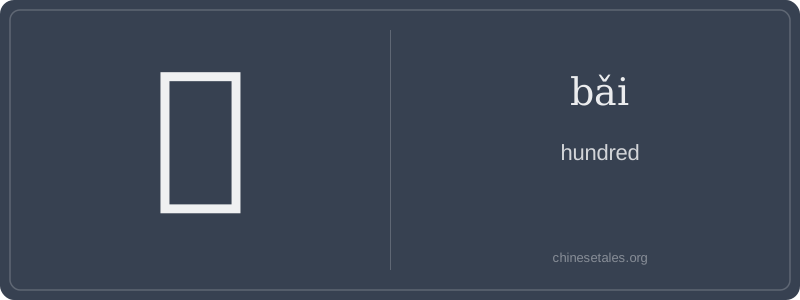
The earliest form of 佰 isn’t found in oracle bones — it emerged later, during the Warring States period, as a variant of 百 designed for clarity in bamboo-slip accounting. Visually, it’s built from 亻 (person radical, hinting at human agency in record-keeping) + 百 (the base hundred character) — but crucially, the top horizontal stroke of 百 is extended leftward to meet the 亻, creating a unified, harder-to-tamper-with glyph. This deliberate ‘locking together’ of person and number reflects its origin: a scribe adding a safeguard stroke to prevent forgery — turning a simple count into a certified unit.
By the Han dynasty, 佰 was codified in financial texts like the *Jiuzhang Suanshu* (Nine Chapters on the Mathematical Art) as part of the ‘capital numerals’ system, alongside 壹 and 贰. Unlike 百 — poetic, flexible, and ancient — 佰 remained rigidly functional: never in poetry, never in idioms, never in speech. Its meaning didn’t shift — it *narrowed*. Where 百 evolved to mean ‘many’ (e.g., 百花齐放 — ‘hundred flowers blooming’), 佰 stayed locked in ledgers, its shape a permanent reminder that in ancient China, trust wasn’t assumed — it was inked, stroke by deliberate stroke.
Imagine you’re at an ancient Chinese military muster — a general stands before 100 soldiers, each holding a bamboo tally stick. He doesn’t say ‘bǎi’ with the common 百 (hundred), but calls out ‘bǎi!’ using 佰 — because this character was born not for counting sheep or birthdays, but for *accounting*, *banking*, and *official documents* where fraud had to be impossible. That’s the vibe of 佰: it’s the ‘anti-fraud hundred’, used almost exclusively in formal financial contexts like banknotes, invoices, and legal contracts.
Grammatically, 佰 never stands alone like 百 does (e.g., 一百). Instead, it appears only in compound numerals — always after 千 or 万 — as part of the ‘financial numeral system’: 壹、贰、叁…玖、拾、佰、仟、萬. So you’ll see 伍佰 (wǔ bǎi) on a ¥500 banknote, but never *佰* by itself — that would sound like quoting a ledger aloud at a tea house. Learners often mistakenly substitute 佰 for 百 in casual speech or writing; native speakers will instantly flag it as either a bank clerk’s tone or a typo.
Culturally, 佰 is one of China’s ‘anti-counterfeit characters’ — deliberately complex (8 strokes vs. 百’s 6) so no one can easily alter ‘one hundred’ into ‘two hundred’ by adding a stroke. It’s a quiet guardian of trust in money, echoing the same logic behind English ‘five’ vs. ‘5’ on checks. You won’t hear it in conversation — but if your landlord hands you a contract with ‘叁佰圆整’, you’ll know exactly how seriously they take that rent.