佬
Character Story & Explanation
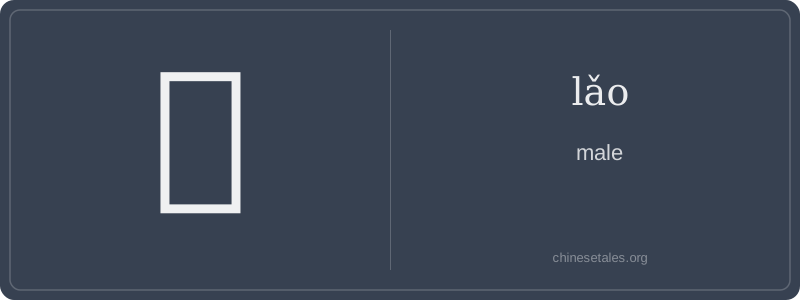
The earliest form of 佬 appears not in oracle bones but in late Ming and Qing vernacular texts — it’s a relatively young character, born from phonetic borrowing and semantic extension. Visually, it’s a clear two-part construction: the left side is 亻(rén bàng), the 'person' radical, signaling human reference; the right side is 老 (lǎo), borrowed purely for its sound (not its meaning 'old'). In seal script and early regular script, the 老 component was written with its full six strokes — three horizontal lines (representing hair), a bent back (), and legs (乚) — evolving into today’s clean, angular 老. The 亻 on the left stabilized early as a shorthand for 'person', making the whole character unmistakably anthropocentric.
Historically, 佬 emerged in southern China as a colloquial intensifier for male roles — first in occupational titles (e.g., 鐵匠佬, 'blacksmith guy'), then broadening to regional identifiers (潮州佬, 'Teochew guy'). Unlike classical characters with philosophical weight, 佬 was forged in street markets and tea houses — pragmatic, rhythmic, and oral-first. Interestingly, classical dictionaries like the Kangxi Zidian didn’t list 佬 at all; it entered formal lexicons only in the 20th century. Its visual reliance on 老 is pure phonetic convenience — like using 'knight' to spell 'night' — a reminder that Chinese writing, like English, happily hijacks familiar shapes for new sounds and social nuance.
Don’t let the simple look of 佬 fool you — this character isn’t a standalone word meaning 'male' in the dictionary sense. It’s a colloquial, often affectionate or teasing suffix attached to nouns (especially occupational or regional terms) to refer to a man associated with that identity: 'tea-uncle' (茶佬), 'Cantonese guy' (廣東佬), or even 'old-timer' (老佬). Think of it as the Chinese equivalent of adding '-guy', '-dude', or '-chap' — warm, informal, sometimes slightly cheeky, and almost always gendered male.
Grammatically, 佬 never stands alone. You’ll never see '他是个佬' — that’s ungrammatical. Instead, it clings like linguistic Velcro: 粤语佬 (yuè yǔ lǎo, 'Cantonese-speaking guy'), 茶佬 (chá lǎo, 'tea enthusiast/tea-seller dude'). Crucially, tone matters: though written as lǎo, in compound words it’s usually pronounced with neutral tone (lǎo → lǎo̯), especially in southern varieties like Cantonese and Hakka where it’s most alive. Learners mistakenly treat it as a noun root or confuse it with 老 (lǎo, 'old') — but 佬 has zero connection to age; it’s about identity, attitude, and belonging.
Culturally, 佬 carries regional flavor — it thrives in Guangdong, Hong Kong, and overseas Cantonese communities, and feels distinctly grassroots. Calling someone a '港佬' (gǎng lǎo) isn’t derogatory — it’s like saying 'a proper Hong Kong lad'. But use it outside those contexts without rapport, and it can sound jarringly slangy or even mildly dismissive. Also beware: while 佬 is male-coded, its feminine counterpart isn’t 乸 (nǎ, a vulgar Cantonese term) — there’s no symmetrical, polite female version. That asymmetry tells its own story about language and gender.