佪
Character Story & Explanation
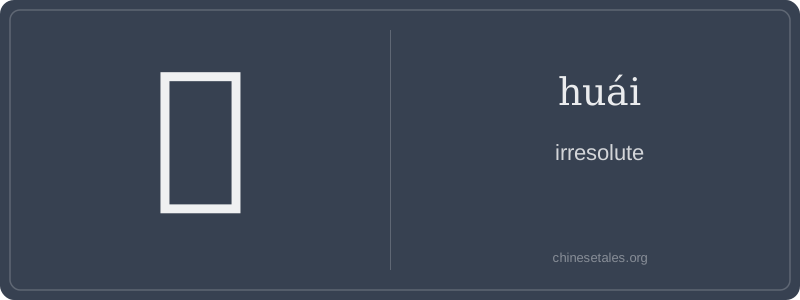
The earliest form of 佪 appears in bronze inscriptions as a combination of 人 (rén, 'person') and 回 (huí, 'to circle, return'), with the person radical on the left and 回—originally a pictograph of swirling water or a winding path—on the right. Over time, 回 simplified from a square-with-inner-spiral into its modern box-with-corners shape, while the 人 radical condensed into the 亻('person') form we see today. Visually, it’s a person literally entwined with circular motion—a human figure caught in a loop.
This image crystallized into the meaning 'irresolute' during the Warring States period, appearing in texts like the Zhuangzi to describe sages pausing mid-step—not out of fear, but to honor complexity. By the Tang dynasty, poets like Li Bai used 佪 in lines such as '低佪不能去' ('lingering low, unable to depart'), where the character’s visual echo of circling mirrors the emotional stasis. Its shape doesn’t just suggest movement—it embodies psychological orbit: no exit, no collapse, only sustained, dignified suspension.
Imagine a scholar standing at a moonlit pavilion, pacing back and forth—hands clasped, brow furrowed—not because he’s lost, but because every path forward feels equally right *and* wrong. That restless circling, that mental hovering before commitment? That’s huái (佪). It’s not mere hesitation like 犹豫 (yóu yù); it’s deeper, more poetic: a soul suspended in quiet turbulence, caught between duty and desire, tradition and change.
Grammatically, 佪 is almost always found in classical or literary compounds—not as a standalone verb, but as the second character in disyllabic words like 低佪 (dī huái) or 徘佪 (pái huái). You’ll rarely see it in modern spoken Mandarin; instead, it appears in poetry, essays, or formal writing to evoke emotional gravity. Learners often mistakenly treat it like a verb meaning 'to hesitate' and try to say '他佪了'—but that’s ungrammatical. It only works in fixed, rhythmically balanced phrases where it contributes weight and resonance, never action.
Culturally, 佪 carries the hush of classical introspection. It’s the pause before a Confucian choice, the breath held before a Daoist surrender. Mistake it for casual doubt, and you miss its elegance: this isn’t indecisiveness—it’s moral deliberation made visible. Modern writers use it sparingly, like a single ink blot in a minimalist scroll: too much ruins the balance, just one speaks volumes.