佧
Character Story & Explanation
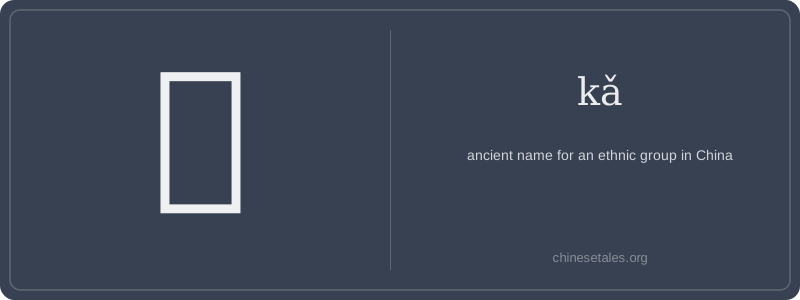
佧 has no oracle bone or bronze script ancestry—it’s a 20th-century coinage. Designed in the 1950s during China’s Ethnic Identification Project, it was constructed from scratch using the human radical 亻 (indicating ‘person/group’) and the phonetic component 卡 (kǎ), which itself means ‘card’ or ‘checkpoint’ but was borrowed here solely for its sound. Visually, it’s minimalist: two strokes for the 亻 radical (‘person’), then five strokes forming 卡—but simplified: the top horizontal of 卡 is omitted, leaving just the vertical and the angular ‘mouth-like’ frame. So 7 strokes total: 亻 (2) + 卡 minus top stroke (5) = 佧. Its clean, angular shape was likely chosen for typographic clarity in early printing and ethnographic surveys.
The meaning emerged entirely from bureaucratic necessity—not classical literature or folk etymology. Before standardization, Wa people were variously written as 瓦、斡、娃, or even transliterated with Japanese katakana in colonial-era texts. The state linguists selected 佧 because 卡 (kǎ) was phonetically precise and neutral, while 亻 signaled ‘ethnic group’—a subtle but deliberate visual cue distinguishing it from place names or objects. Though never used in pre-modern texts, its form echoes older phonosemantic principles: ‘person’ + ‘sound clue’. Today, it survives only in archival documents and older signage—making it one of Chinese’s rarest purpose-built characters.
佧 (kǎ) isn’t a character you’ll encounter in daily conversation—it’s a linguistic fossil, preserved almost exclusively in the term 佧佤族 (Kǎwǎzú), the former official Chinese name for the Wa people of Yunnan. In Chinese, this character carries no independent meaning or grammatical function; it’s purely phonetic and ethnographic—a syllable placeholder with historical weight. Unlike common characters that flex as verbs, adjectives, or measure words, 佧 only appears in proper nouns, always paired (usually with 佤). Its existence reflects how Mandarin handles foreign ethnic names: not by translation, but by carefully selected, tone-matching characters that sound close to the original pronunciation (Wa → kǎ-wǎ), while avoiding homophones with negative connotations.
Grammatically, 佧 is inert—it never stands alone, never takes particles, never appears in idioms or compounds outside its fixed ethnic designation. Learners sometimes mistakenly treat it like a regular noun (e.g., trying to say ‘a 佧 person’) or confuse it with similar-looking radicals. But in real usage, it’s always part of the rigid compound 佧佤族—and even there, modern official usage has largely shifted to just 佤族 (Wǎzú), making 佧 a quietly fading relic. Its pinyin ‘kǎ’ is deceptively simple, but the ‘k’ is aspirated and sharp—like a quick cough—so beginners often soften it to ‘gǎ’, missing the precise ethnolinguistic marker.
Culturally, 佧 embodies China’s mid-20th-century ethnic classification project: characters were deliberately chosen for minority names to signal recognition without assimilation—to honor phonetic authenticity while embedding groups within the Han-character script system. It’s a tiny glyph carrying big politics: respect encoded in sound, identity preserved in stroke order. Mistaking it for a functional word—or worse, omitting it when referencing historical documents—can obscure important sociolinguistic context about how minority identities were formalized on paper.