泆
Character Story & Explanation
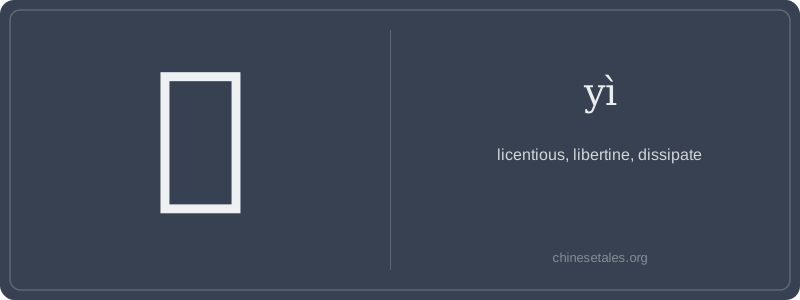
The earliest form of 泆 appears in Warring States bamboo slips as a variant of 溢, sharing the same ‘water’ radical and phonetic component 易. But while 溢 retained its original meaning of physical overflow, 泆 underwent semantic narrowing: scribes began using it specifically when water imagery metaphorically described human excess — hence the shift from ‘spilling liquid’ to ‘spilling morality.’ Its eight strokes crystallized by the Han dynasty: three dots for water (氵), followed by 易 (yì) — a character originally depicting a lizard-like creature changing skin (hence ‘change,’ ‘ease’), now repurposed here to suggest ‘easy virtue,’ ‘effortless dissolution’ of restraint.
This visual pun — water + ‘ease’ — became culturally potent. In the Book of Rites (Lǐjì), 泆 appears in passages warning against ‘excess in joy leading to 泆德 (dissolute virtue),’ linking bodily pleasure to ethical collapse. By the Tang, poets like Bai Juyi used 泆 in ironic, self-reproachful lines: ‘My old age brings only 泆思 — licentious thoughts I cannot quell.’ The character’s shape thus embodies a profound ancient idea: moral failure isn’t dramatic sin — it’s quiet, slippery, *liquid* erosion.
Think of 泆 (yì) as the linguistic equivalent of a spilled wine glass at a decadent banquet — it’s not just 'bad behavior,' it’s a vivid, almost physical image of moral overflow: water (氵) gushing beyond its bounds, symbolizing unrestrained desire, indulgence, or ethical leakage. In classical Chinese, it’s an adjective describing people or conduct that’s morally dissolute — never neutral, always judgmental, and almost always literary or critical in tone.
Grammatically, 泆 is rare in modern spoken Mandarin and functions almost exclusively as a descriptive adjective before nouns (e.g., 泆行 ‘licentious conduct’) or in compound words. You’ll almost never see it alone in a sentence like ‘He is 泆’ — instead, it appears in tightly packed, formal phrases: 泆德 (dissolute virtue), 泆欲 (unrestrained desire). Learners often mistakenly treat it like a verb (‘to be licentious’) or confuse it with common words like 溢 (yì, ‘to overflow’), but 泆 carries no neutral or physical sense — every usage drips with moral censure.
Culturally, 泆 evokes Confucian anxiety about self-cultivation: when inner restraint fails, moral ‘water’ spills out uncontrollably. It’s a character you’ll encounter reading pre-Qin texts or Ming-Qing moral critiques — not WeChat chats. A classic mistake? Using 泆 where 溢 fits (e.g., saying ‘water 泆ed’ instead of 溢了). Remember: 溢 = water overflowing physically; 泆 = virtue/desire overflowing morally. The difference isn’t subtle — it’s ethical gravity vs. physics.