沬
Character Story & Explanation
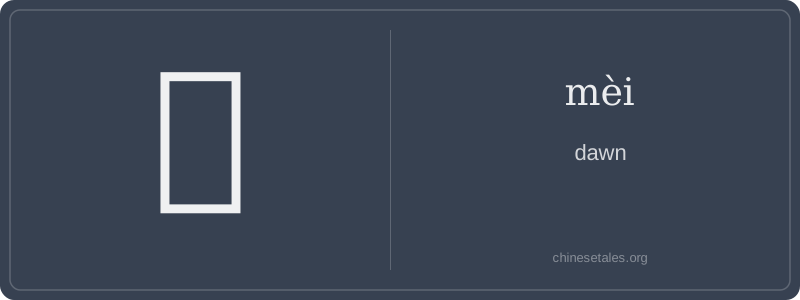
The earliest form of 沬 appears in bronze inscriptions from the Western Zhou (c. 1046–771 BCE), not oracle bones. Visually, it’s a clear compound: the left side is 氵 (the ‘water’ radical, simplified from 水), while the right is 未 (wèi, ‘not yet’ — originally a pictograph of tree branches spreading, symbolizing ‘not fully grown’ or ‘not yet complete’). In early script, 未 was drawn with four short strokes atop a vertical line — representing budding twigs — and 氵 was three wavy dots. Together, they suggested ‘water under the not-yet-sun’: the riverlit by the first faint light before full sunrise.
Over centuries, the 未 component stabilized into its modern shape, and the water radical condensed into the three-dot form. By the Han dynasty, 沬 was already used metonymically: the Mèi River became synonymous with the eastern horizon where dawn broke — hence its semantic shift from proper noun to abstract time-word. The *Shījīng* (Ode 242, ‘Dà Yǎ’) references ‘Mèi Shuǐ’ as a boundary river near the Zhou ancestral lands, anchoring the character in real geography before it blossomed into poetic metaphor. Its quiet persistence — unchanged for 3,000 years — makes it a rare semantic bridge between Bronze Age hydrology and classical Chinese lyricism.
Let’s start with the vibe: 沬 (mèi) isn’t your everyday ‘dawn’ — it’s poetic, archaic, and almost liturgical. It evokes the hushed, silver-grey moment just before sunrise when mist clings to rivers and the world holds its breath. Unlike the common word for dawn (黎明 língmíng) or morning (早晨 zǎochén), 沬 carries a classical resonance, appearing mostly in literary texts, poetry, or set phrases — never in casual speech or modern news headlines. You won’t hear it in a weather report; you’ll find it in Tang dynasty verse or Song dynasty essays.
Grammatically, 沬 functions exclusively as a noun — never a verb or adjective — and almost always appears in compound words or fixed expressions. It rarely stands alone. For example, you’d say 沬水 (Mèi Shuǐ, an ancient river name), not *‘mèi yīn’ (‘dawn shade’) — that would sound invented. Learners sometimes try to use it like ‘morning’ in sentences like *‘wǒ qǐ mèi’ (‘I get up at dawn’), but that’s ungrammatical; native speakers use 拂晓 (fúxiǎo) or 黎明 instead. The character resists modern syntactic adaptation — it’s a linguistic fossil, beautifully preserved but not actively evolving.
Culturally, 沬 is tied to geography as much as time: its earliest attestation is as the name of the Mèi River (in present-day Henan), mentioned in the *Classic of Poetry* (*Shījīng*). Because rivers often flow eastward — toward the rising sun — the name subtly fused place and time: ‘the river where dawn breaks’. This double meaning explains why 沬 feels both temporal and topographic. A common mistake is overgeneralizing it to mean ‘mist’ (due to the water radical), but its core semantic anchor is *light-at-dawn*, not moisture — though mist *at* dawn is poetically implied.