沔
Character Story & Explanation
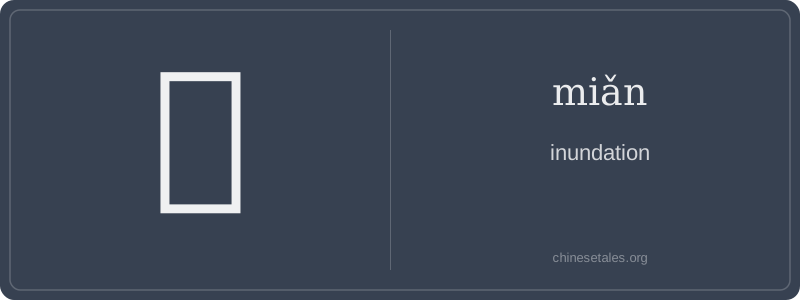
The earliest form of 沔 appears in Warring States bamboo slips, not oracle bones — a clue to its relatively late emergence. Visually, it’s a masterclass in phono-semantic compounding: left side 氵 (three water dots, simplified from 水) signals 'water-related'; right side 免 (miǎn) provides both pronunciation and subtle semantic resonance — in ancient script, 免 depicted a kneeling person removing a cap, implying 'removal' or 'escape,' which metaphorically aligns with water escaping its banks. Stroke by stroke, the modern form solidified: dot-dot-dot (氵), then the four strokes of 免 (a slanted line, curved hook, horizontal, and downward stroke) — seven strokes total, mirroring the unpredictability of floodwaters.
Over time, 沔’s meaning narrowed from 'overflowing water' to anchor a specific geography: the Mian River, a major tributary of the Han River flowing through Hubei. It appears in the *Shījīng* (Ode 246): '沔彼流水,朝宗于海' ('That overflowing stream flows eastward, paying homage to the sea') — where 沔 vividly evokes the river’s surging, unstoppable momentum toward the ocean. This classical usage cemented its dual identity: a concrete place name fused with an abstract, almost mythic force of nature — water not as resource, but as sovereign, boundary-defying power.
At first glance, 沔 feels like a quiet character — just three water drops and a simple 'miǎn' sound — but don’t be fooled: it’s a semantic fossil from ancient hydrology. Its core meaning isn’t generic 'water' or 'river,' but specifically *inundation*: the overwhelming, boundary-dissolving flood that rises over banks and swallows land. In classical Chinese, it was almost exclusively used as a proper noun — the name of the Mian River in Hubei — but its radical 氵 (water) + phonetic 免 (miǎn) subtly preserved the sense of water *escaping control*, like something ‘exempt’ (the meaning of 免) from containment. That duality — river name + flood imagery — still echoes today in literary or historical contexts.
Grammatically, 沔 is nearly extinct as a standalone verb or adjective in modern Mandarin; you won’t hear someone say '河水沔了' (‘the river flooded’). Instead, it appears almost exclusively in place names (e.g., 沔阳 Miǎnyáng), classical allusions, or poetic compounds like 沔水 (Miǎn River). Learners often mistakenly treat it as a general synonym for ‘flood’ (like 洪 or 涨), but using 沔 outside proper nouns sounds archaic or jarringly literary — like saying 'thou' instead of 'you' at a coffee shop.
Culturally, 沔 carries the weight of the Han River basin’s ancient ecology: the Mian River was part of the cradle of Chu culture, mentioned in the *Classic of Poetry* (Shījīng) and later revered in Tang poetry for its mist-shrouded, turbulent beauty. A common mistake? Confusing it with 沐 (mù, ‘to bathe’) or 勉 (miǎn, ‘to strive’) — both share the 免 component but lack the water radical and flood connotation. Remember: 沔 isn’t about effort or cleansing — it’s about water *overrunning*. Always ask: ‘Is this a place name or a poetic flood?’ If not, you’re probably using the wrong character.