汶
Character Story & Explanation
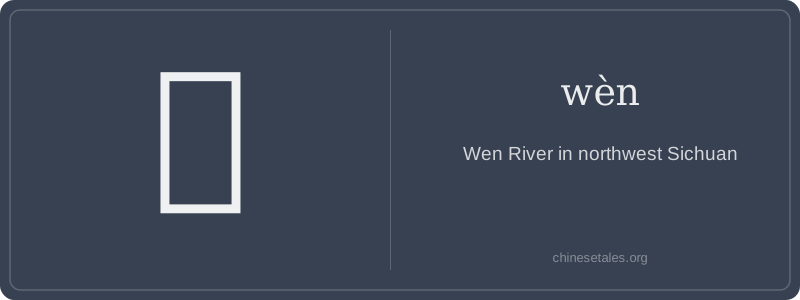
The earliest form of 汶 appears in bronze inscriptions from the Western Zhou dynasty (c. 1046–771 BCE), where it was written as ⿰水文 — with 水 (water) on the left and 文 (wén, ‘pattern’ or ‘culture’) on the right. The original pictograph wasn’t a literal river scene but a phonetic-semantic compound: 氵 (a simplified water radical) signaled ‘water-related’, while 文 provided the sound *wén* — later shifting to wèn due to tonal evolution in Middle Chinese. Over centuries, the top horizontal stroke of 文 shortened, the dot became standardized, and the whole right side compacted, yielding today’s sleek seven-stroke form: 氵 + 文, now visually balanced but audibly distinct.
This character’s meaning stayed remarkably stable: from its first appearance in the *Shuǐjīng Zhù* (Commentary on the Waterways Classic, 6th c. CE), 汶 named the river flowing past ancient Shu Kingdom settlements. Unlike many characters whose meanings drifted (e.g., 走 once meant ‘run’), 汶 held fast — a testament to how deeply place names root language in land. In classical poetry, it appears sparingly but evocatively: Du Fu once referenced ‘Wen River mists’ to evoke Sichuan’s ethereal beauty — not as scenery, but as identity. Visually, the three dots of 氵 ripple like river eddies; 文’s crossbar and dot suggest both human settlement and the river’s orderly flow — nature and culture, inseparable.
Think of 汪 (wèn) not as a standalone word you’ll use daily, but as a proper noun anchor — like ‘Nile’ or ‘Seine’ in English. It’s almost exclusively tied to the Wen River (Wèn Jiāng), a real, fast-flowing tributary of the Min River in northwestern Sichuan, winding through misty gorges near Wenchuan County. Its meaning isn’t abstract or metaphorical: it *is* geography. You won’t say ‘I drank some 汶’ — it doesn’t mean ‘water’ generically. It only appears in place names, historical texts, or geographical descriptions, always with that quiet, specific weight of a river’s name carved into landscape and memory.
Grammatically, 汶 functions like other river-name characters (e.g., 黄 for Yellow River): it rarely stands alone, but pairs with 河 (river), 江 (large river), or 县 (county). So you’ll see 汶江 (Wèn Jiāng) — not *just* ‘Wen River’, but *the* Wen River, with cultural gravitas. Learners sometimes misread it as wén (like 文) — but no, it’s wèn, with that falling tone that mimics the river’s descent from the Qionglai Mountains. And crucially: it’s never used as a verb or adjective. If you try to say ‘to wen something’, you’ll get blank stares — it’s purely nominal and locative.
Culturally, this character carries quiet resonance. After the 2008 Wenchuan earthquake, 汶 appeared constantly in news reports — not just as geography, but as a symbol of resilience. Yet learners often overgeneralize, thinking it means ‘any mountain river’ or confuse it with common water-related words like 波 (wave) or 清 (clear). Remember: 汶 is a name, not a description — like calling the Thames ‘Thames’, not ‘gray river’. Its power lies in precision, not poetry.