汳
Character Story & Explanation
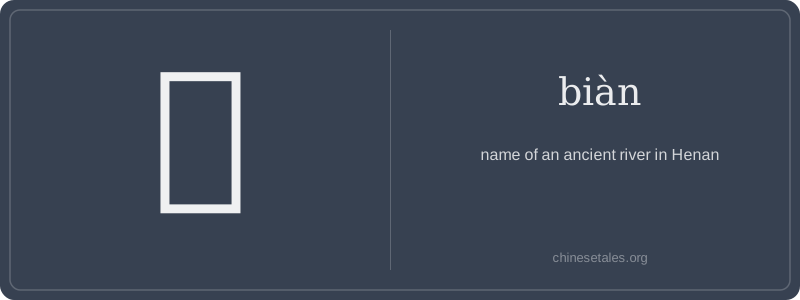
The earliest form of 汳 appears in Warring States bamboo slips — not oracle bones — as a flowing water radical (氵) paired with 辯 (biàn, 'to distinguish') as phonetic, but simplified over centuries. Originally, it likely depicted a tributary branching off the Yellow River near modern Kaifeng, its three-dot water radical anchoring the idea of flow, while the right side evolved from a complex 辯-like component into the streamlined 变-like shape we see today — a visual echo of how rivers 'change' (变) course over time, yet retain their name. Stroke order reflects this: first the water dots (left), then the sweeping horizontal and hook of the right-hand component — mimicking water spilling and turning.
By the Han dynasty, 汳 was firmly established in geographical texts like the Book of Han as a distinct river east of Luoyang, crucial for irrigation and transport. Its name survives only in classical allusions and place-name etymologies — for example, the Tang poet Du Fu mentions ‘the banks of the 汳’ when lamenting lost homelands. The character’s quiet persistence — unchanged for over two millennia, yet functionally extinct — mirrors the river itself: gone from the land, but indelible on the page.
Think of 汳 (biàn) like the 'Nile of Henan' — a forgotten river that once carved history into the Central Plains, much like how the Thames shaped London or the Tiber defined Rome. But unlike those famous rivers, 汳 appears almost exclusively in ancient texts and historical geography: it’s not a living word in modern speech, nor is it used metaphorically or poetically today. It’s a proper noun with zero grammatical flexibility — no verbs, no adjectives, no compounds in daily use. You’ll never say 'I crossed the 汳' in contemporary Mandarin; you’ll only encounter it when reading Sima Qian’s Records of the Grand Historian or studying Han-dynasty maps.
Grammatically, 汳 functions solely as a rigid geographical name — always capitalized in effect, though Chinese has no capital letters. It never takes aspect particles (了, 过), doesn’t combine with measure words, and can’t be modified by adjectives. Learners sometimes misread it as biān (like 边) or try to force it into modern place-name patterns (e.g., confusing it with 汴, the old name for Kaifeng). But no — it’s a fossilized term, like 'Thames Estuary' in English: precise, archaic, and context-bound.
Culturally, 汳 embodies how Chinese writing preserves hydrological memory: even when rivers dry up or change course (and the ancient 汳 vanished centuries ago), the character remains — an ink-and-brush time capsule. Mistake it for similar-looking characters? You’re not just mispronouncing — you’re misplacing ancient geography. And since it’s absent from HSK, textbooks, and apps, encountering it feels like finding a Roman coin in a Beijing alley: rare, authentic, and quietly thrilling.