汩
Character Story & Explanation
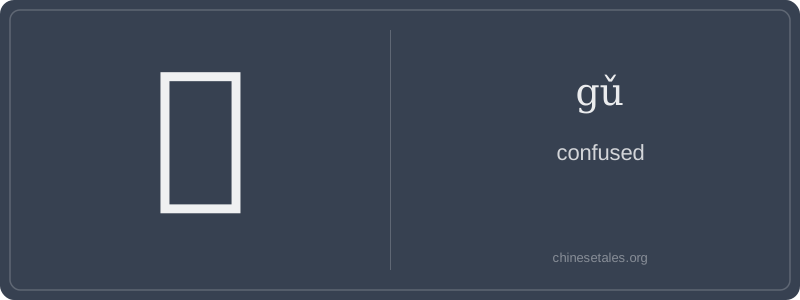
The earliest form of 汩 appears in Warring States bamboo slips — a slender, flowing script where the left side clearly shows three water dots (氵), and the right side resembles 古 (gǔ), but with a subtle twist: the top stroke curves downward like a ripple, and the bottom horizontal is slightly tilted, evoking water gurgling *upward* — not flowing smoothly, but churning, escaping containment. Over centuries, clerical script standardized the right component into 古, but preserved that restless tilt; by Tang dynasty regular script, the seven strokes were fixed: three dots, then 古’s five strokes — yet the tension remains in the unbalanced weight of the lower part.
This visual tension mirrors its semantic journey. In the Chu Ci (Songs of Chu), 汩 appears in lines like ‘汩余若将不及兮’ — ‘I rush on, fearing I’ll fall behind,’ where it conveys urgent, disorienting haste. Later, in Han dynasty commentaries, it acquired the nuance of ‘mental muddiness’ — as if clear thought had been stirred like silt in a stream. The character doesn’t just describe confusion; it *enacts* it: its shape resists easy parsing, its sound (gǔ) is short and guttural — like a choked breath — and its very presence signals that language itself is beginning to slip.
Imagine you’re reading an ancient scroll in a dusty library, and the ink seems to swirl on the page — not from moisture, but as if the characters themselves are dissolving into confusion. That’s the visceral feeling of 汩 (gǔ): not just ‘confused’ in the abstract, but *visually* and *sonically* disordered — like water bubbling up chaotically, blurring boundaries and scrambling sense. It’s a literary, almost poetic word: you won’t hear it in daily chat or HSK dialogues, but it appears in classical allusions, essays, and formal writing to evoke mental turbulence, disorientation, or chaotic flow.
Grammatically, 汩 is almost always used as a verb or adjective in compound structures — never alone. You’ll see it in reduplicated forms like 汩汩 (gǔ gǔ) for continuous, unsettling flow (of water, time, or thoughts), or in literary phrases like 汩乱 (gǔ luàn), meaning ‘to throw into chaos’. Crucially, it’s *not* interchangeable with common synonyms like 迷糊 (mí hu) or 混乱 (hùn luàn): 汩 carries a quieter, more lyrical unease — less about shouting ‘I’m lost!’ and more about whispering ‘my thoughts are leaking away like water through cracks.’
Learners often misread it as yù (like 育) or mistake it for 汨罗 (Mìluó — the famous river), but its tone is firmly third-tone gǔ. And while it shares the water radical (氵), it’s not about calm streams — it’s about turbulent, undercurrent-like confusion that erodes clarity from within. Its rarity makes it a ‘secret handshake’ character: spotting it shows you’ve ventured beyond textbooks into real literary Chinese.