汏
Character Story & Explanation
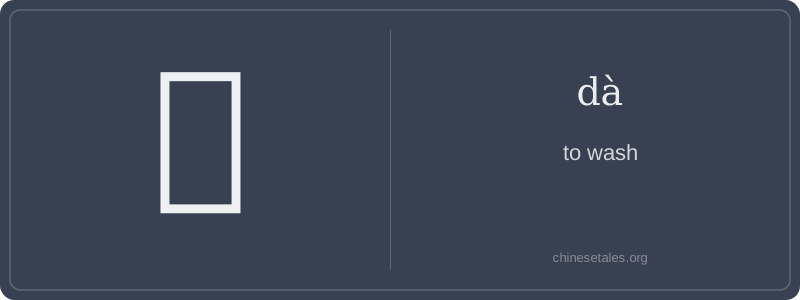
The character 汏 has no oracle bone or bronze script ancestry — it’s a later folk creation. Its form is a deliberate simplification: take the left radical of 洗 (the 'water' radical 氵) and replace the right side (先) with the much simpler and visually dominant 大 (dà, 'big'). This wasn’t scholarly invention but grassroots orthography — scribes and printers in Jiangnan during the Ming–Qing period wanted a faster, bolder way to write 'wash' in everyday Wu speech, where the word sounded like 'dà'. Stroke-wise, it’s just three dots (氵) + 大 — no hidden complexity, just pragmatic visual efficiency.
This simplification reflects how dialect writing evolved outside imperial orthographic control. Unlike classical characters refined over centuries, 汏 emerged from market stalls and teahouses — functional, phonetic, and unapologetically local. You won’t find it in the Kangxi Dictionary, but you *will* spot it in early 20th-century Shanghai tabloids and handwritten Wu opera libretti. Its meaning didn’t shift — it simply anchored the Wu pronunciation of 'wash' to a memorable, high-frequency shape (大), turning phonetic convenience into enduring regional identity.
Hold on — before you reach for your dictionary, let’s clear up the biggest surprise: 汏 isn’t standard modern Mandarin at all. It’s a regional variant (mainly in Wu dialects like Shanghainese and Suzhounese) of 洗 (xǐ), meaning 'to wash'. Its pronunciation dà is a local phonetic adaptation — not a Mandarin reading — and it carries the same core action but with a distinctly colloquial, earthy flavor. Think of it as the linguistic equivalent of using 'bath' as a verb in British English ('I’ll bath the baby') — perfectly natural in its home turf, but absent from formal textbooks.
Grammatically, 汏 behaves just like 洗: it’s a transitive verb, often followed by an object (e.g., 汏衣服) or used in aspectual constructions with 了 or 过. But crucially, it almost never appears in written Standard Chinese — you’ll hear it in Shanghai alleyways, see it in Wu-language song lyrics or local theater scripts, but *never* in HSK exams, news reports, or official documents. Learners who encounter it without context often misread it as 大 (dà, 'big') — a classic shape-sound trap that turns 'I washed the rice' into 'I big the rice'!
Culturally, 汏 is a quiet marker of linguistic resilience: it preserves an ancient pronunciation (Middle Chinese *dɑH*) that faded in northern speech but thrived in the south. Its absence from the HSK list isn’t oversight — it’s intentional gatekeeping. Mistaking it for a 'standard' character leads to confusion; embracing it as a dialectal treasure opens doors to Shanghai opera, Wu folk songs, and real neighborhood banter. The key? Treat 汏 like a local password — useful only where it’s spoken, and always with respect for its regional roots.