氦
Character Story & Explanation
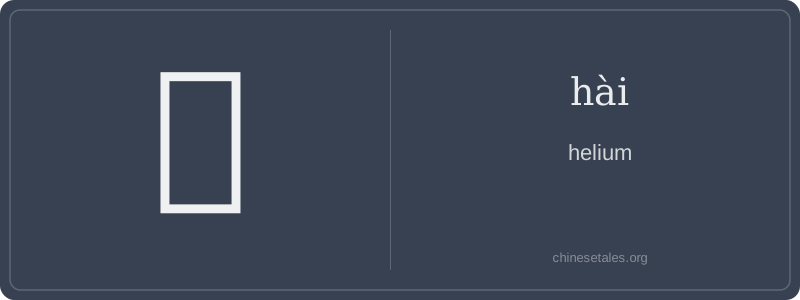
The character 氦 didn’t exist in oracle bone or bronze inscriptions — it’s a 20th-century neologism, created around 1933 by Chinese chemists standardizing chemical nomenclature. Its structure is deliberately transparent: the left ‘qi’ radical (气) — drawn originally as three wavy lines representing rising vapor — anchors it firmly in the ‘gaseous’ semantic family. The right side, 咳, is a pre-existing character meaning ‘to cough’, composed of ‘mouth’ (口) + ‘the sound *gāi/hài*’ (亥). When designing 氦, linguists selected 咳 *not* for its meaning, but for its pronunciation — a clever phonetic loan. Stroke-by-stroke, it flows: first the three horizontal waves of 气 (strokes 1–3), then the mouth radical (stroke 4), followed by the complex ‘hai’ component (strokes 5–10), whose upper part (亠 + 丿 + 丶) and lower ‘hai’ (亥) mirror classical forms found in Shuowen Jiezi.
Historically, 氦’s meaning leapfrogged straight from Western science into Mandarin — no classical literature references, no Daoist or medical texts mention it. But its visual logic is deeply classical: like 氧 (oxygen), 氮 (nitrogen), and 氯 (chlorine), it follows the Ming-Qing tradition of using radicals to classify substances — here, 气 signals physical state, just as 氵 signals liquid or 火 signals heat/combustion. The ‘cough’ component may seem absurd at first glance, but it’s a testament to Chinese lexicography’s pragmatism: when you need a reliable, unambiguous *hài* sound for a new element, borrow the most common existing character that delivers it — even if it means helium ‘coughs’ its way into the periodic table.
氦 (hài) is a modern scientific character — born not in ancient rituals or poetry, but in 20th-century chemistry labs. Its core meaning is pure and elemental: helium, that light, inert, non-reactive noble gas we associate with floating balloons and deep-space telescopes. Visually, it’s built on the ‘qi’ radical (气), which literally means ‘air’, ‘vapor’, or ‘energy’ — a perfect semantic home for any gaseous element. The right side, 咳 (hài), isn’t just phonetic decoration; it’s the actual sound-alike borrowed from the word for ‘cough’ — yes, the same sound you make when clearing your throat! That’s why 氦 is pronounced *hài*, not *ké* or *hē*. It’s a brilliant piece of linguistic recycling: no new sound invented, just repurposed.
Grammatically, 氦 behaves like other chemical element names in Chinese — it’s a noun, rarely used alone, almost always in compounds (e.g., 氦气, 液氦). You’ll never say *‘I breathe helium’* as a standalone verb phrase; instead, it appears in technical contexts: measurements (‘helium concentration’), engineering specs (‘helium-cooled magnets’), or safety warnings (‘helium asphyxiation risk’). Learners sometimes misread it as *hēi* (like 黑) or *kǎi* (like 凯), but the tone mark and the ‘qi’ radical are your anchors: *hài*, always falling tone, always gaseous.
Culturally, 氦 carries zero traditional symbolism — no folklore, no poetic resonance. That’s its charm: it’s a linguistic time capsule of China’s rapid scientific modernization. In the 1930s–40s, Chinese chemists faced the urgent task of coining characters for Western elements while preserving logic and readability. 氦 was part of that elegant, systematic solution — where every element’s name tells you both *what it is* (gas → 气) and *how to say it* (hài → 咳). No wonder it’s absent from the HSK list: it’s not daily-life vocabulary, but it *is* a masterclass in how Chinese adapts to the future without losing its roots.