氡
Character Story & Explanation
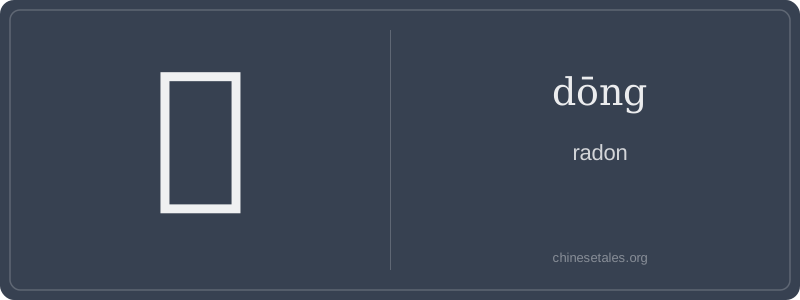
The character 氡 didn’t exist in oracle bone or bronze inscriptions — it’s a 20th-century neologism, created around 1930 by Chinese chemists standardizing elemental names. Its structure is deliberately synthetic: the top radical 气 (qì) — originally a pictograph of rising steam or breath — sits above 冬 (dōng), a fully developed character meaning ‘winter’, borrowed here purely for its sound. Visually, the nine strokes form a clean, top-heavy balance: three horizontal wavy lines (气) suggesting gaseous movement, capped by the compact, angular strokes of 冬 — two dots, a horizontal, a sweeping hook, and a final downward stroke. No ancient glyph morphed into this; it was drafted like a chemical formula: precise, legible, reproducible.
Meaning-wise, 氡 emerged from necessity, not evolution. Before the 1930s, radon had no standardized Chinese name — texts used transliterations like ‘尼特罗恩’ (nítèluō’ēn) or vague terms like ‘ emanation’. When the Committee on Scientific Terminology convened in Nanjing, they applied strict rules: gases get 气; sounds must match international pronunciation (Rn → ‘dōng’, approximating ‘ron’ via Mandarin phonotactics). So 氡 wasn’t discovered in bamboo slips — it was voted into existence, a testament to how modern Chinese builds vocabulary not through centuries of drift, but through deliberate, collaborative design.
氡 (dōng) is a scientific loan character — not born from ancient philosophy or daily life, but engineered in the early 20th century to name the radioactive noble gas radon. Its presence reveals how modern Chinese handles scientific terminology: by blending phonetic precision with semantic intuition. The radical 气 (qì, 'vapor/air') instantly signals it’s a gaseous substance — no guesswork needed — while the phonetic component 冬 (dōng, 'winter') gives the sound. This isn’t poetic metaphor; it’s functional design, reflecting China’s pragmatic embrace of Western science during the Republican era.
Grammatically, 氡 behaves like any chemical element noun: it’s uncountable, never takes measure words like 个, and almost always appears in technical collocations — never standalone in speech. You’ll see it in phrases like 氡气 (radon gas) or 氡浓度 (radon concentration), but you’d never say *‘一个氡’ or *‘氡很重’. Learners sometimes misread it as ‘dòng’ (like 动) or confuse it with 同 (tóng), leading to garbled pronunciation in lab reports or safety briefings — a small slip that could undermine credibility in professional settings.
Culturally, 氡 carries quiet urgency: it’s odorless, colorless, and the second-leading cause of lung cancer worldwide. Yet in Chinese discourse, it rarely appears in headlines — it’s a ‘background hazard’, discussed in building codes and geology papers, not dinner-table chat. That silence speaks volumes: Chinese environmental awareness often prioritizes visible pollution (smog, rivers), while invisible threats like radon linger in technical margins — a subtle reminder that language reflects not just what we know, but what we choose to name aloud.