氖
Character Story & Explanation
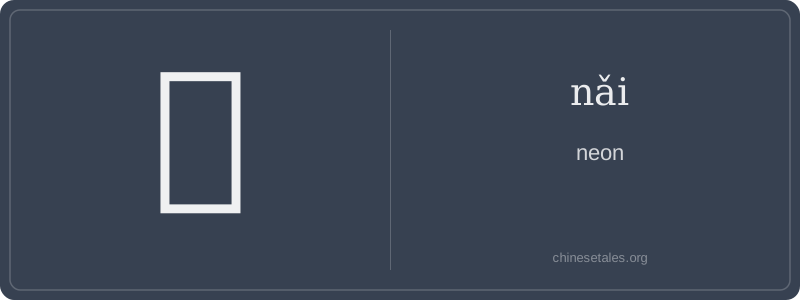
The character 氖 didn’t exist before the 20th century — no oracle bones, no bronze inscriptions, no seal script. It was invented around 1933 by Chinese chemists adapting Western scientific terms. Its structure is deliberately transparent: the left radical 气 (qì, 'gas') signals category, while the right component 昜 (yáng, an archaic variant of 'sunlight' or 'radiance', now read nǎi here) was chosen for phonetic approximation to 'neon' — though the pronunciation shifted from expected yáng to nǎi due to systematic tone adjustments in chemical nomenclature. Visually, its six strokes flow cleanly: three horizontal strokes for 气’s top (like rising vapor), then three more for 昜 — two short diagonals and a long sweeping捺 (nà), evoking both light emission and linguistic economy.
Historically, 氖 carries none of the cosmological weight of 气 (which once meant 'vital breath' or 'cosmic energy'), nor the alchemical mystique of early elemental names. Instead, it represents a moment of pragmatic linguistic engineering — where tradition bowed to precision. Classical texts never mention it, of course, but its very existence reflects a quiet revolution: the integration of global science into Chinese without abandoning logographic logic. The shape doesn’t depict neon gas (invisible and colorless!), but rather *how neon behaves*: luminous under electricity (hence 昜’s solar connotation) yet chemically aloof — perfectly mirrored in its serene, balanced, six-stroke form.
Think of 氖 (nǎi) as Chinese chemistry’s version of a neon sign in Times Square — dazzling, inert, and unmistakably modern. Unlike ancient characters born from nature or ritual, 氫 is a 20th-century creation: a scientific loan character designed specifically for the noble gas neon. Its meaning is purely technical and unambiguous — it *only* means 'neon' — no poetic extensions, no idioms, no metaphorical uses. You’ll never see it in classical poetry or daily conversation; it lives exclusively in lab reports, physics textbooks, and signage specifications.
Grammatically, 氖 behaves like a noun with zero inflection — no measure words required when naming the element itself (e.g., 氖是一种惰性气体), but it *does* take classifiers like 种 ('type') or 瓶 ('bottle') when quantified (e.g., 一瓶氖气). Crucially, it almost always appears in compounds (like 氖灯 or 氖气), not alone — using 氖 by itself sounds as odd as saying 'neon' instead of 'neon light' or 'neon gas' in English. Learners often mistakenly treat it like a verb or try to use it adjectivally — but it has no verbal form, no -ed/-ing derivatives, and no standalone descriptive power.
Culturally, this character embodies China’s rapid scientific modernization: it was coined in the 1930s during the Standardization of Scientific Terminology movement, modeled after Western chemical nomenclature. A common mistake? Pronouncing it as 'nài' (like 耐) — but the tone is third (nǎi), matching its phonetic component 昜 (yáng → nǎi via historical sound shift). Also, don’t confuse it with 氮 (dàn, nitrogen) — their radicals are identical, but the right-hand components differ entirely.