毡
Character Story & Explanation
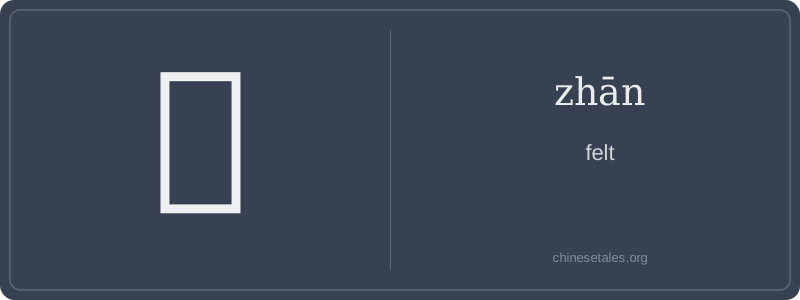
The earliest form of 毡 appears in Han dynasty seal script — not oracle bone, since felt-making postdates those inscriptions. Visually, it merges 毛 (a stylized tuft of hair, three downward strokes + a curl) on the left with 真 (a simplified version of the ancient character for 'genuine', originally showing a ritual vessel and 'eye' — signifying truth and presence) on the right. Over centuries, the top of 真 shrank from a complex lid-like shape to the clean + 目 structure we see today, while 毛 retained its unmistakable 'furry' silhouette — nine strokes total, each one echoing the layered, matted quality of wool fibers pressed together.
This character crystallized during the Northern Dynasties (4th–6th c. CE), when Central Asian pastoral cultures deeply influenced northern China. The Book of Wei (魏书) notes Xianbei tribes using 'zhan' for tents and saddle pads — and the character’s form mirrors that process: hair (毛) + 'truthful substance' (真) = material so authentically dense it needs no thread. Even today, the compound 毡房 (zhān fáng, 'yurt') preserves this ancient link — not 'hair house', but 'felt-made dwelling', where every stroke breathes warmth and wind resistance.
Think of 毡 not as just 'felt' — the fuzzy, compressed wool fabric — but as 'hair-made solidity': its radical 毛 (máo, 'hair') isn’t decorative; it’s the core ingredient. The right side 真 (zhēn) doesn’t mean 'true' here — it’s a phonetic clue (zhān sounds close to zhēn), but more importantly, it subtly evokes authenticity and density: real, unspun wool matted into something substantial. In Chinese, 毡 is almost always a noun, rarely a verb, and nearly never used alone — you’ll see it in compounds like 毡帽 (zhān mào, 'felt hat') or 毡毯 (zhān tǎn, 'felt rug').
Grammatically, it behaves like other material nouns: no measure words needed when specifying type ('a wool-felt cap'), but requires one for counting ('one felt hat' = 一顶毡帽 yī dǐng zhān mào). Learners often misread it as 真 because of the right side — but 真 has ten strokes and means 'true', while 毡 has nine and means only 'felt'. Also, don’t confuse it with 毯 (tǎn, 'rug') — that’s a broader term; 毡 specifies *how* the rug is made: by felting, not weaving.
Culturally, 毡 carries nomadic resonance: Mongolian yurts use thick felt walls for insulation, and Tibetan herders make portable felt blankets — so 毡 implies resilience, warmth, and craft, not just texture. You won’t find it in daily HSK speech, but it appears in historical texts, museum labels, and craft contexts. A common slip? Writing 毡 as 毯 by accident — which changes 'felt boot' (毡靴) into 'rug boot' (毯靴), an absurdity that’ll make a native speaker blink twice.