毓
Character Story & Explanation
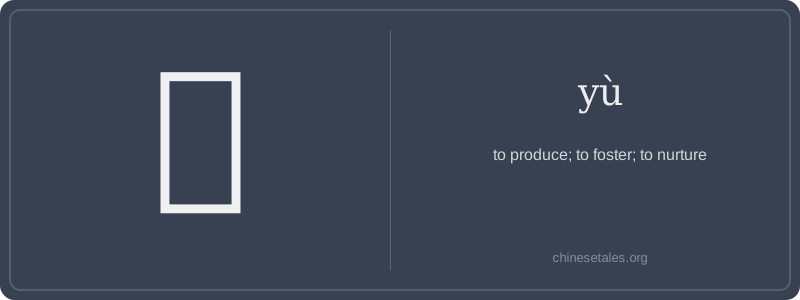
The earliest form of 毓, seen in bronze inscriptions (c. 1000 BCE), was a vivid pictograph: a kneeling woman (the precursor to 母, 'mother') cradling a sprouting plant — roots descending, stem rising, leaves unfurling. Over centuries, the plant evolved into the top component (⺭, a variant of 亠 + 王-like strokes), while the woman solidified into the radical 母 below. By the seal script era, the 'sprout' had stylized into three parallel horizontal strokes above a simplified 'mother', and the final clerical script added the distinctive hook at the bottom right — preserving the sense of life emerging *from* the maternal source.
This visual logic never wavered: 毓 has always meant 'to bring forth through nurturing care'. In the Book of Rites, it appears in passages on how virtuous rulers 'foster harmony' (毓和), linking moral authority to generative power. Later, in Tang poetry and Ming genealogies, it described how mountains 'nurture eminent scholars' (毓俊), framing geography itself as a living, cultivating force. The character’s enduring power lies in this fusion: the maternal radical doesn’t just mean 'mother' — it signifies the foundational, sustaining source from which all flourishing originates.
At its heart, 毓 (yù) is the quiet hum of life being coaxed into being — not brute force creation, but gentle, sustained nurturing: a teacher shaping a student’s mind, soil fostering seedlings, or tradition cultivating virtue. It carries an almost ritual gravity; you won’t hear it in casual chat ('I’ll nurture my plants today!') — it belongs to formal writing, classical allusions, and dignified contexts like education policy or ancestral lineage records. Its core feeling is *intentional, respectful, long-term cultivation* — think 'foster' more than 'make', 'nurture' more than 'build'.
Grammatically, 毓 is almost always transitive and appears in compound verbs or literary phrases. You’ll rarely see it alone; it pairs with nouns (e.g., 毓才 'foster talent') or functions as the verb in elegant set phrases (e.g., 钟灵毓秀 'a place where spiritual energy gathers and nurtures excellence'). Learners sometimes misread it as a synonym for 生 (shēng, 'to give birth') or 培养 (péiyǎng, 'to train'), but 毓 implies deeper, more organic, even metaphysical growth — less classroom instruction, more cosmic alignment.
Culturally, 毓 echoes Confucian ideals of self-cultivation and generational responsibility. It’s embedded in names (especially historical/elite ones), temple inscriptions, and regional slogans praising landscapes that 'nurture outstanding people'. A common mistake? Using it where modern Mandarin would use 培养 or 教育 — sounding archaic or pompous. Also, watch tone: yù (4th) is easily confused with yǔ (3rd, 'to give') or yū (1st, rare), so context and tone marks are non-negotiable.