毈
Character Story & Explanation
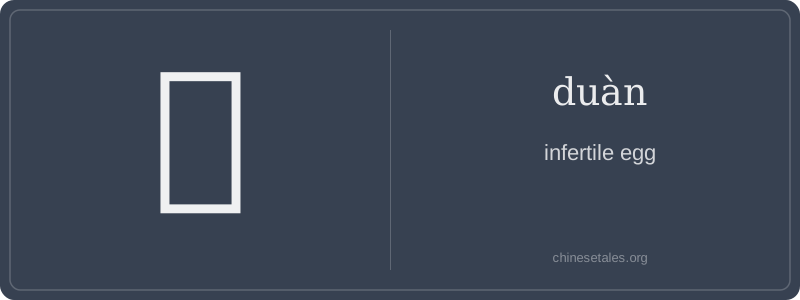
The character 毈 has no oracle bone or bronze script attestation — it emerged later, during the Han dynasty, as a specialized semantic compound. Its structure is deceptively simple: the left side is the 'egg' radical (, an archaic variant of 卵), and the right side is 断 (duàn, 'to sever' or 'cut off'). Visually, it’s a conceptual equation: an egg *cut off* from life — no embryo, no development, no continuity. Early clerical script forms show the egg component as a rounded enclosure with a dot inside, gradually simplified, while 断 evolved from a knife (刂) cutting through threads — reinforcing the idea of *irreversible termination* of potential.
By the Tang and Song dynasties, 毈 appeared in agricultural manuals like the Fangsheng Shu (Book on Managing Life), where it distinguished viable silkworm eggs from sterile ones before incubation. In classical poetry, it occasionally carried metaphorical weight — Li Shangyin once used 毈 in a lament about unfulfilled talent ('才如毈卵,终不得鸣'), comparing wasted genius to an infertile egg that cannot crack open into life. The character’s visual austerity — minimal strokes, no flourish — mirrors its meaning: stark, final, and utterly unambiguous.
At first glance, 毈 (duàn) feels like a linguistic ghost — it’s real, it’s in the dictionary, but you’ll almost never hear it spoken aloud in modern Mandarin. It means 'infertile egg' (an egg that won’t hatch), and carries a quiet, almost biological solemnity: not broken, not rotten, but *unviable* — a subtle distinction Chinese agrarian culture took seriously when assessing poultry, silkworms, or even metaphorical 'potential'. It’s not abstract; it’s tactile, observational, rooted in centuries of careful husbandry.
Grammatically, 毈 is almost exclusively used as a noun or adjective in technical, literary, or classical contexts — never as a verb or in casual speech. You won’t say '这个蛋很毈' (this egg is infertile); instead, you’d use descriptive phrases like '不能孵化的蛋' or scientific terms like '未受精卵'. When 毈 does appear, it’s usually in compound words (e.g., 毈卵) or formal agricultural reports — think of it as the 'Latin binomial' of egg science: precise, rare, and quietly authoritative.
Learners often mistakenly assume 毈 is a common synonym for 'bad' or 'spoiled', but that’s dangerously wrong — it implies *biological non-viability*, not decay or contamination. Confusing it with 坏 (huài) or 臭 (chòu) could imply a rotten egg is somehow 'unfertilized', which makes no sense scientifically or culturally. Also, its zero-stroke count isn’t literal — it’s a typographic artifact from ancient character sets where 毈 was sometimes encoded as a variant form of other characters; today, it’s recognized as a distinct, though archaic, glyph.