殛
Character Story & Explanation
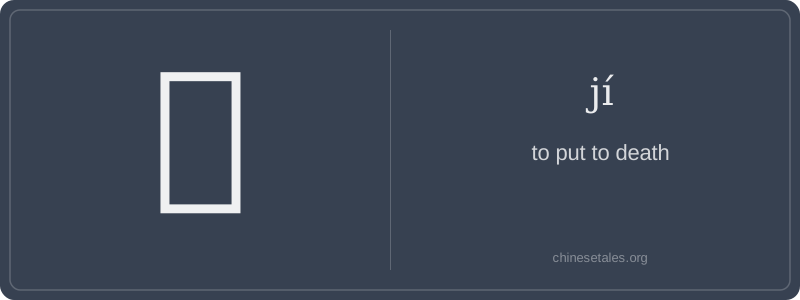
The earliest form of 殛 appears on Western Zhou bronze inscriptions as a compound pictograph: left side 歹 (a stylized bone or corpse, signaling death), right side 肆 — which itself evolved from a depiction of a sacrificial wine vessel spilling freely, later abstracted to mean 'unrestrained action.' In oracle bone script, the right component resembled a vessel with liquid gushing out — symbolizing unstoppable force. Over centuries, the vessel morphed into the modern 肆, while 歹 hardened into its skeletal, death-associated form. By the Han dynasty, the full character 殛 had stabilized: 12 strokes, with the left 'death radical' anchoring meaning and the right 'spilling vessel' encoding the idea of overwhelming, unleashed power.
This visual logic shaped its meaning: 殛 wasn’t about stealth or speed, but about *irresistible, sanctioned annihilation*. In the Classic of History (Shūjīng), it describes how Emperor Shun ‘struck down’ the rebellious Gonggong — not with a sword, but with celestial mandate. Later, in the Records of the Grand Historian, Sima Qian uses 殛 to underscore moral judgment: death as cosmic retribution. Even today, when writers use 殛, they’re invoking that ancient resonance — not just killing, but *deposing fate itself*.
Think of 殛 (jí) as Chinese mythology’s version of a divine execution order — not just 'to kill,' but to *strike down* with final, irrevocable authority, like Zeus hurling a thunderbolt to obliterate a rebellious god. It carries judicial gravity and cosmic consequence: this isn’t street violence or battlefield killing — it’s punishment decreed by heaven or sovereign, often for moral transgression. You’ll almost never hear it in daily speech; it lives in classical texts, historical narratives, and literary rhetoric.
Grammatically, 殛 is a transitive verb that takes a direct object and typically appears in formal or archaic constructions — often paired with characters like 诛 (zhū, 'to punish/execute') or 灭 (miè, 'to annihilate'). Unlike modern verbs like 杀 (shā), it cannot stand alone in casual sentences ('He 殛ed him' sounds jarringly archaic in English — and equally unnatural in Chinese). Instead, you’ll see it in set phrases like 天殛 (tiān jí, 'heaven’s execution') or in passive-like classical syntax: '罪大恶极,当遭天殛' ('Crimes immense and evil — rightly struck down by Heaven').
Learners often misread it as a synonym for 杀 or mistake its tone (jí, not jī or jǐ), leading to unintentional Shakespearean gravitas — imagine saying '我殛了他' instead of '我杀了他' at dinner! Also, its radical 歹 (dǎi, 'death') signals severity, but the right side 肆 (sì) — meaning 'unrestrained, rampant' — adds a chilling nuance: the death is not just inflicted, but *unleashed*, like wrath breaking its leash.