歺
Character Story & Explanation
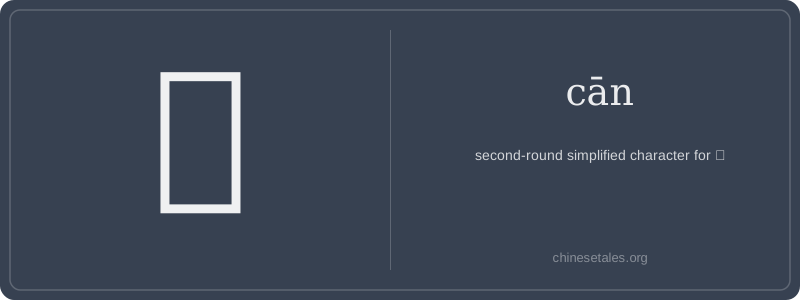
Look closely at 歺: those five stark strokes aren’t abstract — they’re a bone. Specifically, an ancient pictograph of a human femur (or sometimes a skull), carved into oracle bones over 3,000 years ago. The top horizontal stroke is the head end; the descending vertical is the shaft; the three short strokes branching left, right, and down? Joint fragments — knees, condyles, or marrow cavities. Over centuries, as bronze inscriptions hardened and clerical script flattened forms, this bony glyph lost its organic curves and became angular, geometric, and hauntingly minimal — exactly five strokes, no more, no less.
But here’s the twist: this bone wasn’t originally about eating. It meant 'death', 'corpse', or 'remains' — a stark, visceral symbol of mortality. Only much later, during Han dynasty semantic borrowing, did it get pressed into service as a phonetic component in characters like 死 (sǐ, 'to die') and eventually, via sound-alike association, attached to 餐 as a simplified stand-in. Classical texts never used 歺 for 'meal'; that’s a 20th-century administrative afterthought. Its skeleton still whispers death — while pretending to serve lunch.
Let’s be honest: you’ll almost never see 歺 in real life — and that’s the whole point. It’s a ghost character: officially listed in the 2013 General Standard Chinese Character Table as a second-round simplified variant of 餐 (cān, 'meal'), but it’s deliberately obsolete, like a linguistic museum exhibit. In spoken and written Mandarin today, 餐 is universal — from 餐厅 (cān tīng, 'restaurant') to 早餐 (zǎo cān, 'breakfast'). 歺 exists only to show how far simplification *could* have gone: stripping away 食 (food)’s full radical for a skeletal, five-stroke shorthand. Its 'meaning' isn’t culinary — it’s bureaucratic archaeology.
Grammatically, 歺 functions identically to 餐: as a noun meaning 'meal', always appearing in compounds (never standalone), and never as a verb. You won’t say 'I 歺' — just like you wouldn’t say 'I 餐'. Learners sometimes try to use it like a verb or write it alone thinking it’s 'cool shorthand', but native speakers will blink, then gently correct you with 餐. Its usage is zero in speech, near-zero in print — even in dictionaries, it’s marked 'rare' or 'archaic variant'.
Culturally, 歺 reveals China’s pragmatic attitude toward script reform: not all simplifications survived the editing room. It was proposed, reviewed, and quietly shelved — a reminder that language change isn’t linear, but curated. The biggest mistake learners make? Assuming rarity equals authenticity. No — 歺 isn’t 'more classical' than 餐; it’s less used, less loved, and functionally extinct. Respect it like a fossil: interesting to study, useless to chew on.