歜
Character Story & Explanation
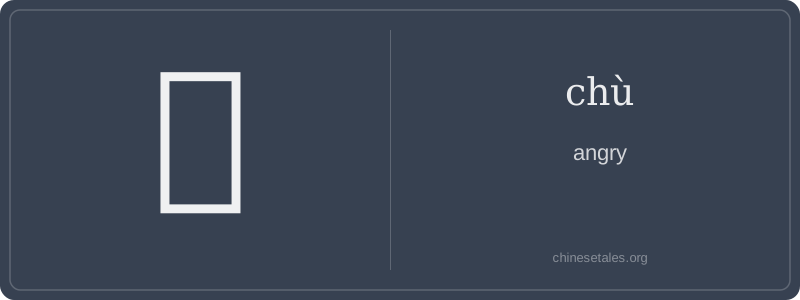
The earliest form of 歜 appears in Warring States bamboo slips, not oracle bones — and it’s a masterclass in visual intensity. Its left side, 虍 (hū), is the ‘tiger’ radical: not the animal itself, but the stylized pattern of tiger stripes — jagged, fierce, undulating. The right side, 蜀 (shǔ), originally depicted a silkworm cocoon with writhing threads, later repurposed phonetically. Over centuries, the tiger’s stripes tightened into sharp, angular strokes, while 蜀 simplified from a detailed insect glyph to its current form — merging into a compact, tense structure that looks like a coiled spring about to snap.
This visual tension mirrors its semantic journey: in the Book of Songs (Shījīng), 歜 appears once — in a line describing a minister’s sudden, righteous wrath at court corruption (‘其怒如雷,其色如歜’). By the Han dynasty, it was already rare, preserved only in literary registers to evoke primal, unmediated emotion. The tiger radical anchors it to ferocity; 蜀 adds phonetic resonance and a subtle connotation of something tightly wound, restless, and alive — like silk unraveling under pressure. No wonder it vanished from daily use: few emotions demand such precise, ancient architecture.
Imagine a Tang dynasty scholar, ink still wet on his brush, slamming it down after reading an imperial edict he finds unjust — his face flushed, jaw clenched, eyes blazing. That raw, wordless fury isn’t just ‘angry’ in English; it’s 歜 (chù), a character that captures not everyday irritation but *righteous, visceral, almost physical outrage*. It’s archaic, literary, and rarely used alone — you’ll almost never see it outside classical poetry or highly stylized prose.
Grammatically, 歜 functions as an adjective or verb modifier, often paired with other characters to intensify emotional gravity: think 歜怒 (chù nù) — ‘fury that shakes the rafters’, or 歜然 (chù rán) — ‘suddenly flaring up in indignation’. Unlike modern words like 生气 (shēngqì) or 愤怒 (fènnù), 歜 doesn’t take objects, doesn’t combine freely with aspect particles (了, 过), and absolutely never appears in spoken Mandarin or beginner textbooks — which is why learners who stumble upon it in a Song dynasty poem often misread it as a typo or confuse it with 咻 (xiū) or 嘱 (zhǔ).
Culturally, 歜 carries Confucian weight: it describes the kind of anger deemed morally permissible — anger at injustice, hypocrisy, or betrayal of principle — not petty grudges. Mistake it for a common synonym, and you’ll miss the moral texture of the text. And yes — its stroke count isn’t zero (that’s a red herring!); it has 14 strokes, but its rarity makes it feel like a ghost character, haunting classical texts but refusing to appear in modern life.