歔
Character Story & Explanation
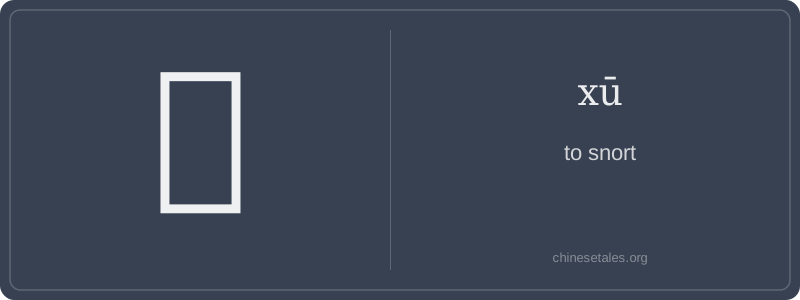
Trace 歔 back to its earliest forms, and you’ll find no simple pictograph — it’s a phonosemantic compound born in the Warring States period. The left side, 欠 (qiàn), is the 'yawning' radical — originally a kneeling figure with open mouth, later generalized to all mouth-related actions involving breath or voice. The right side, 虛 (xū), is both phonetic (giving the sound xū) and semantic (meaning 'empty', 'hollow', evoking the hollow resonance of a snort or sob). Over centuries, the complex 虛 component simplified into today’s 16-stroke structure, but the breath-and-emptiness duality remained etched in every line.
In classical texts like the Shiji (Records of the Grand Historian), 歔 appears paired with 欷 to describe mourners at funerals — not wailing loudly, but trembling with suppressed sobs, their breath catching audibly. By the Tang dynasty, poets like Du Fu used 歔欷 to convey profound, wordless sorrow — the kind that bypasses language and erupts as raw nasal exhalation. Its visual form mirrors this: the 'open mouth' radical 欠 anchors the action, while the intricate, layered strokes of the right side evoke the choked, layered quality of grieving breath — not one sound, but a cascade of breaths collapsing inward.
At its core, 歔 (xū) is a visceral, onomatopoeic verb capturing the sharp, involuntary expulsion of air through the nose — not quite a sniffle, not quite a scoff, but that raw, breathy 'huff' you make when choking back tears, suppressing laughter, or reacting to something absurd or poignant. It’s deeply embodied: you feel it in your sinuses and chest, not just hear it. Unlike neutral verbs like 呼 (hū, 'to exhale') or 吸 (xī, 'to inhale'), 歔 carries emotional texture — often sorrow, grief, suppressed emotion, or quiet indignation.
Grammatically, 歔 is almost always used in reduplicated form 歔欷 (xū xī), a classical disyllabic compound meaning 'to sob convulsively' or 'to weep with gasping breaths'. You’ll rarely see it standalone in modern speech; it’s literary, poetic, and formal — think elegies, historical novels, or solemn speeches. Trying to use it like a regular verb ('他歔了一下') sounds jarringly archaic or unnatural. Instead, it appears in fixed expressions like 欷歔不已 (xī xū bù yǐ, 'unable to stop sobbing') or as part of four-character idioms.
Culturally, 歔 connects to ancient Chinese conceptions of breath (qi) as inseparable from emotion — grief literally catches in the throat and flares in the nostrils. Learners often misread it as 虚 (xū, 'empty') due to identical pinyin and similar stroke count, leading to nonsensical translations like 'he emptied his nose'. Also, don’t confuse it with 嘘 (xū, 'shush!') — same sound, totally different mouth shape and intent. This character doesn’t silence; it *releases*.