歆
Character Story & Explanation
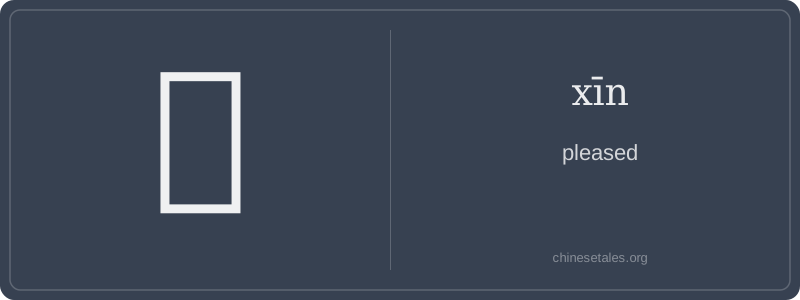
The earliest form of 歆 appears on Shang dynasty oracle bones and Western Zhou bronzes as a pictograph combining two key elements: ‘xīn’ (the phonetic component, later standardized as 欣 without 忄) and ‘欠’ (qiàn), the radical meaning ‘to open mouth in sigh or breath’. Visually, it depicted a person breathing deeply — not in exhaustion, but in awe or sacred inhalation, as if drawing in the fragrance of incense or the presence of ancestors. Over centuries, the top evolved from a simplified ‘xīn’ shape into today’s ‘音’-like upper structure (though unrelated to 音), while the lower ‘欠’ retained its open-mouthed posture — 13 strokes total, each echoing ritual breath and reception.
This visual logic shaped its meaning: 歆 was never about personal emotion, but about *spiritual resonance*. In the Classic of Poetry (Shījīng), it appears in hymns describing ancestral spirits ‘xin xiang’ — delighting in sacrifices. By the Han dynasty, its usage broadened slightly to describe human admiration (e.g., ‘xin xian’), but always retaining a tone of respectful, almost reverent longing — never envy or casual liking. The ‘欠’ radical anchors it in embodied response: you don’t just think it — you *breathe it in*, physically and spiritually.
Imagine you’re at an ancient Zhou dynasty ancestral shrine: incense curls upward, bronze bells chime softly, and a priest lifts a freshly cooked sacrificial offering — not for himself, but for the spirits. In that hushed, reverent moment, the word 歆 (xīn) flickers like candlelight: it’s not just ‘pleased’ in the modern sense of ‘I’m happy about my coffee’ — it’s the deep, sacred *pleasure of spirits accepting offerings*, or the profound human joy that arises when reverence is met with divine favor. This character lives almost exclusively in classical, literary, or ritual contexts — never in casual speech or HSK-level texts.
Grammatically, 歆 functions as a verb (often transitive) meaning ‘to delight in’ or ‘to receive with pleasure’, especially in set phrases like ‘歆享’ (xīn xiǎng — ‘to accept and enjoy [an offering]’) or as part of compound nouns like ‘歆羡’ (xīn xiàn — ‘to admire deeply, with yearning’). You’ll never say ‘我歆这个电影’ — that would sound bizarrely archaic or even comically pretentious. Instead, it appears in elegant written prose, poetry, or formal inscriptions — think of it as Chinese’s ‘liturgical adjective-verb hybrid’.
Culturally, 歆 carries quiet weight: it bridges human devotion and spiritual reciprocity. Learners often misread it as ‘excited’ (confusing xīn with xīng) or overgeneralize its usage into everyday verbs. Remember: 歆 isn’t about your mood — it’s about *alignment*: between ritual and response, effort and reward, mortals and the unseen. Its rarity makes it a subtle marker of textual sophistication — spotting it tells you you’ve stepped out of the textbook and into the classics.