欿
Character Story & Explanation
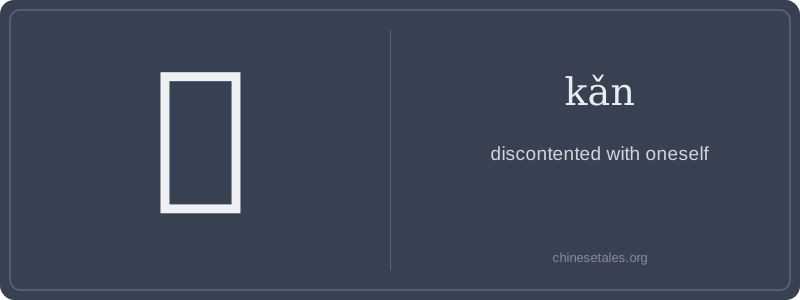
The earliest form of 欿 appears in bronze inscriptions of the Western Zhou (c. 1046–771 BCE) as a compound pictograph: a kneeling figure (the precursor to 亼, later simplified to 今) above a mouth (口), all anchored by the ‘reclining’ radical 欠—suggesting someone bowing low while breathing out a sigh. Over centuries, the kneeling figure evolved into 今 (jīn, ‘now’), and the mouth merged stylistically with the lower part, giving rise to today’s 12-stroke structure: 今 + 欠. Crucially, the ‘mouth’ wasn’t about speaking—it was about the physical act of exhaling regret, a visible release of inner unease.
This visual origin directly shaped its meaning: 欿 never meant ‘complaining aloud’ but rather ‘the silent, embodied realization of one’s inadequacy’. In the Book of Rites (Lǐjì), it appears in passages describing how a gentleman, upon hearing criticism, would ‘kǎn rán cháng xī’ (sigh deeply in self-dissatisfaction)—not defensively, but as ritualized humility. The character’s shape itself enacts the posture: the top 今 implies immediacy (‘right now, I see my flaw’), and the bottom 欠 evokes the involuntary sigh—the body confessing before the mind articulates.
At its core, 欿 (kǎn) is a rare, literary character that expresses a quiet, inward-facing dissatisfaction—not with the world, but with oneself. Think of it as the Chinese linguistic cousin to 'self-reproach' or 'humbling discontent': not anger, not shame, but a sober, almost dignified awareness of one’s own shortcomings. It carries a classical, introspective weight—like catching your own reflection and sighing, not in despair, but in recognition.
Grammatically, 欿 functions almost exclusively as a verb (or sometimes an adjective in fixed literary phrases), always requiring a subject who is doing the self-assessing—and it never takes an object. You can’t be 欿 *something*; you’re simply 欿 *yourself*. So while you might say ‘tā duì zìjǐ gǎndào kǎn’ (he feels discontented with himself), you’d never say ‘kǎn zhè ge shì’ — that construction doesn’t exist. Learners often misapply it like a synonym for ‘bù mǎnyì’ (dissatisfied), but 欿 is untranslatable without the reflexive nuance: it’s dissatisfaction *that folds back onto the self*, like origami made of conscience.
Culturally, 欿 echoes Confucian ideals of self-cultivation: the virtuous person isn’t complacent—they constantly measure themselves against higher standards. It appears mostly in pre-modern texts or highly stylized modern writing (e.g., essays on moral philosophy). A common mistake? Confusing it with 坎 (kǎn, ‘pit’ or ‘hardship’) due to identical pinyin—but they share no semantic ground. Also, don’t try to use it conversationally—it’ll sound like quoting a Ming dynasty scholar at a coffee shop.