欻
Character Story & Explanation
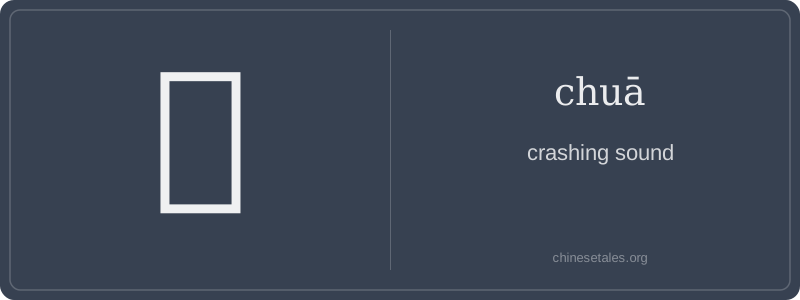
The earliest trace of 欻 lies not in oracle bones, but in late Warring States bronze inscriptions and early clerical script, where it emerged as a phonosemantic compound: the left side 欠 (qiàn), meaning 'to yawn' or 'to open the mouth', originally picturing a person with an open mouth exhaling — here repurposed not for breath, but for *sound emission*. The right side 火 (huǒ, fire) was simplified over centuries into the four-dot ‘fire’ radical at the bottom, while the top evolved from 炔 (què, acetylene — a volatile gas) into today’s abstract squiggle, evoking both flame and explosive motion. Twelve strokes total — each one feels like a spark jumping.
By the Tang dynasty, 欻 had crystallized into a literary onomatopoeia for abrupt ignition or rupture — Li Bai used it to describe lightning splitting clouds; Yuan drama scripts called for actors to shout 欻! before sword-draws. Its visual logic is brilliant: mouth (欠) + fire (火) = sound born of combustion — not gentle warmth, but instant, noisy ignition. Even today, when a child drops a glass and shouts 'chuā!', they’re echoing a linguistic reflex older than printed books — a character that doesn’t describe sound, but *re-enacts* it.
Imagine hearing a sudden, sharp, almost electric crack — like a bamboo stalk snapping in freezing weather or a spark leaping across dry air. That’s 欻 (chuā), not a word you’ll find in textbooks or HSK lists, but one that lives vividly in northern Chinese dialects, folk tales, and classical poetry. It’s not just ‘a sound’ — it’s the *instantaneousness* of rupture: no buildup, no echo, just pure sonic surprise. Think of it as Chinese onomatopoeia’s punk-rock cousin — raw, unfiltered, and grammatically rebellious.
Grammatically, 欻 functions almost exclusively as an interjection or adverbial particle placed *before* a verb to inject suddenness: 欻地一下 (chuā dì yī xià) — 'in one abrupt flash'. You won’t say 'I heard 欻' — instead, you say 欻!灯灭了 (Chuā! Dēng miè le) — 'Crack! The light went out.' Learners often mistakenly treat it like a noun or try to use it with 是 or 很 — but 欻 has zero tolerance for copulas or adjectives. It’s a lightning bolt — it strikes, then vanishes.
Culturally, 欻 thrives where language meets physical sensation — in storytelling, opera, and rural oral tradition. It appears in Ming-Qing vernacular novels like Water Margin, where warriors draw swords with a 欻! — underscoring martial decisiveness. A common mistake? Confusing it with similar-looking characters like 歇 or 欣 — but those carry breath or joy; 欻 carries *shock*. And yes — it *can* be read xū in rare literary compounds (e.g., 欻然, xū rán, meaning 'suddenly', archaic), but chuā is its true, vibrant, throaty voice.