欸
Character Story & Explanation
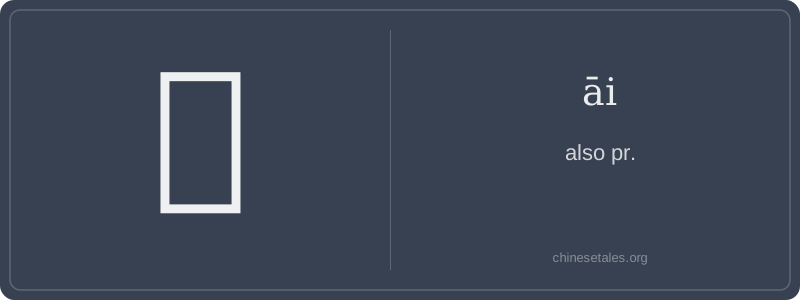
The earliest form of 欸 appears not in oracle bones but in late Warring States bamboo slips and Han dynasty bronze inscriptions, where it evolved from a fusion of two elements: 口 (mouth, radical for speech sounds) and 欠 (a kneeling figure with mouth open, originally depicting someone yawning or sighing). Over centuries, 口 shrank and shifted left, while 欠 — already a complex radical meaning 'lack' or 'to sigh' — absorbed the phonetic component of 爱 (ài, 'to love') in clerical script, though that connection faded. By Tang dynasty regular script, the left side solidified into the simplified 口 we see today, and the right became the 11-stroke 欠-based structure with its distinctive downward hook and dot — a visual echo of an exhaled breath catching mid-air.
This character never meant 'love' or 'lack', despite its components — instead, it captured the *sound* of that breath: a soft, voiced glottal release used to signal presence without dominance. In classical texts like the Shuōwén Jiězì (121 CE), it was glossed as 'a gentle call to attention', and in Ming dynasty vernacular novels, courtesans used 欸 (pronounced ēi) to beckon patrons with polite yet knowing charm — a nuance lost in modern āi but still felt in its melodic lift and slight throatiness.
Think of 欸 not as a word with dictionary meaning, but as a linguistic eyebrow raise — a vocal punctuation mark that carries tone, attitude, and unspoken social calculus. Pronounced āi (first tone) in its most common modern usage, it’s an interjection used to acknowledge, gently interrupt, or express mild surprise — like saying 'Ah!' or 'Oh?' with a raised chin and half-smile. It’s never written in formal texts, rarely taught, and almost always spoken: imagine two friends chatting when one says, 'Āi — nǐ jīntiān chuān de zhè jiàn yīfu hěn piàoliang!' ('Ah — the shirt you’re wearing today is really nice!'). Here, 欸 isn’t filler; it’s a soft social hinge, signaling attentive listening before pivoting.
Grammatically, it stands alone — no subject, no verb, no object. It appears at sentence start (often followed by a pause or comma), never mid-clause or at the end. Learners mistakenly try to use it like 嗯 (‘um’) or 啊 (‘ah!’), but 欸 is more refined and context-sensitive: it implies recognition *plus* light engagement, never hesitation or doubt. Using it with strangers or superiors can sound overly familiar or even cheeky — it’s the linguistic equivalent of leaning in slightly during a conversation among peers.
Culturally, 欸 lives in the liminal space between speech and gesture: it’s how Mandarin speakers ‘nod with their voice’. Its six variant pronunciations (ǎi/ēi/éi/ěi/èi) appear only in regional dialects, literary mimicry (e.g., imitating old opera singers), or poetic meter — not in standard conversational Mandarin. The biggest mistake? Writing it down at all outside dialogue in fiction or scriptwriting. Native speakers rarely see it in print — which is why it’s absent from HSK lists despite being heard daily in Beijing teahouses and Shanghai snack bars.