榄
Character Story & Explanation
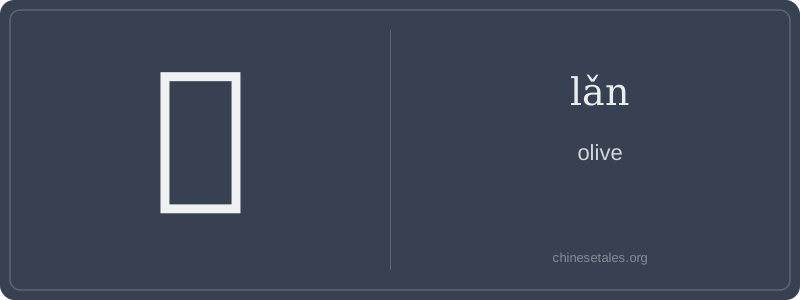
The earliest form of 榄 isn’t found in oracle bones — it’s a relatively late addition to the script, first appearing in seal script during the Warring States period. Its left side 木 (mù, ‘tree’) is straightforward — a pictograph of a tree with roots, trunk, and branches. The right side, 敛 (liǎn), is more intriguing: originally a phonetic component borrowed from the character meaning ‘to gather, to restrain’, written with 攵 (a hand holding a stick) over 佥 (a simplified form of ‘to gather’). Over centuries, 敛 was stylized and compressed, losing its clear ‘hand + gathering’ structure and settling into today’s compact, angular shape — 13 strokes total, with the final stroke of 敛 becoming the downward hook that anchors the whole character.
This phonetic-semantic combo is classic Chinese character logic: 木 tells you it’s plant-related, 敛 tells you how to say it (lǎn, close to liǎn’s ancient pronunciation). By the Tang dynasty, 榄 appeared in medicinal texts describing the ‘bitter, cooling’ properties of the Chinese olive fruit — prized not for oil, but for soothing sore throats and clearing heat. Interestingly, classical poets avoided 榄 entirely; it was too mundane, too culinary. Its rise coincided with Cantonese and Min dialect expansion, where the local olive became a staple condiment — so this character’s story isn’t one of imperial elegance, but of coastal kitchens, salt jars, and generations of mothers preserving summer’s harvest in earthenware crocks.
At first glance, 榄 (lǎn) feels like a quiet, unassuming character — but don’t be fooled. It’s the Chinese word for ‘olive’, yet it carries none of the Mediterranean romance you might expect. In Mandarin, 榄 is almost never used alone; it’s a true team player, appearing only in compound words like 橄榄 (gǎn lǎn) or as part of food names like 榄菜 (lǎn cài). You’ll rarely hear a native speaker say just ‘榄’ — it’s grammatically orphaned, like a last name without a given name. That’s why learners who try to use it solo (e.g., ‘I like 榄’) sound unnatural — it’s not wrong, just jarringly incomplete, like saying ‘—tato’ instead of ‘potato’.
Grammatically, 榄 functions exclusively as a bound morpheme: it needs a partner to form meaning. Its tone (third tone) also trips up beginners — they often default to second tone (lán), especially after the similarly toned gǎn in 橄榄. And while ‘olive oil’ is olive oil in English, Chinese says 橄榄油 (gǎn lǎn yóu), never *榄油 — omitting 橄 makes it unrecognizable. This character refuses to stand alone, and that stubborn teamwork is its linguistic signature.
Culturally, 榄 appears most often in southern Chinese cuisine — think Cantonese preserved olives, Teochew pickled 榄角 (lǎn jiǎo), or Fujianese olive snacks. But here’s the twist: most Chinese people have never tasted a fresh Mediterranean olive — their ‘olive’ is usually a local, bitter-green, salt-cured fruit from the Chinese olive tree (Canarium album), botanically unrelated to Olea europaea. So when you see 榄 on a menu, don’t reach for your Greek salad — you’re about to bite into something uniquely, pungently southern Chinese.