欐
Character Story & Explanation
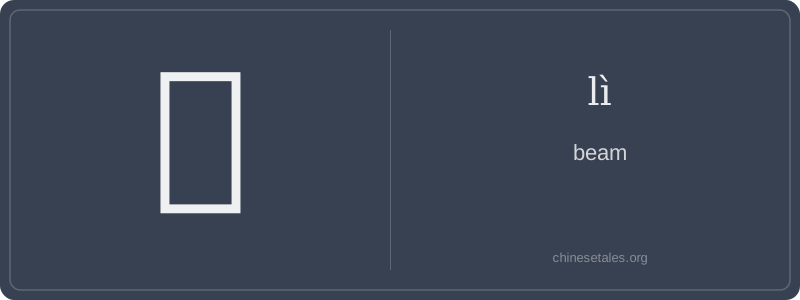
The earliest form of 欐 appears in Han dynasty clerical script (lìshū), not oracle bones — it’s a relatively late-comer to the script. Its left side, 木 (mù), is unmistakably the 'tree/wood' radical, anchoring its material essence. The right side, 厲 (lì), originally depicted a sharp stone blade (厂 + 万 → later stylized) and meant 'sharp, severe'. Combined, the character visually shouted: 'a wood element so critical, so rigorously shaped, it carries the severity of a cutting tool' — not just any timber, but a precisely fitted, load-defining structural member.
By the Tang and Song dynasties, 欐 had crystallized into its current form and became synonymous with the principal transverse beam in bracket sets (dǒugǒng) of imperial architecture. The poet Du Fu wrote of 'carved 欐s trembling under rain' — implying their exposed, elevated role. Interestingly, the character’s sharp-sounding 厲 component also subtly reinforced the idea of precision: every 欐 had to be cut to exact tolerances, lest the entire structure wobble. Its visual duality — wood + severity — thus became a perfect semantic seal: strength isn’t gentle, and architecture isn’t forgiving.
Think of 欐 (lì) as the 'I-beam' of classical Chinese architecture — not the flashy roof or ornate door, but the heavy, load-bearing timber that holds everything up in silence. It means 'beam' specifically: a large horizontal support beam in traditional wooden structures, often carved, painted, and ritually installed with great ceremony. Unlike generic words like liáng (梁) or gǎn (杆), 欐 carries an air of antiquity and structural gravity — it’s the kind of word you’d find in Tang dynasty palace inventories or Song dynasty carpentry manuals, not in modern apartment listings.
Grammatically, 欐 is almost exclusively a noun and rarely appears alone in speech; it thrives in compounds (like 欐柱 or 雕欐) and functions as a literary or technical term. You won’t hear it in daily conversation — even native speakers might pause and recall its meaning from classical texts. Learners sometimes misread it as lǐ (like 里) due to tone confusion, or assume it’s interchangeable with 梁 (liáng), but that’s like calling a steel I-beam a 'rafter' — technically related, but different scale, function, and register.
Culturally, 欐 evokes the philosophy of hidden strength: in traditional Chinese cosmology, beams symbolize the 'horizontal axis' that harmonizes heaven (roof) and earth (foundation). Mistaking 欐 for a simple 'wooden stick' misses its ritual weight — in ancient temple construction, the first beam was offered incense and inscribed with auspicious characters. Modern learners’ biggest trap? Using it where 梁 or 栋 would be natural — this character doesn’t just mean 'beam'; it means *the* foundational beam — solemn, singular, and historically resonant.