欀
Character Story & Explanation
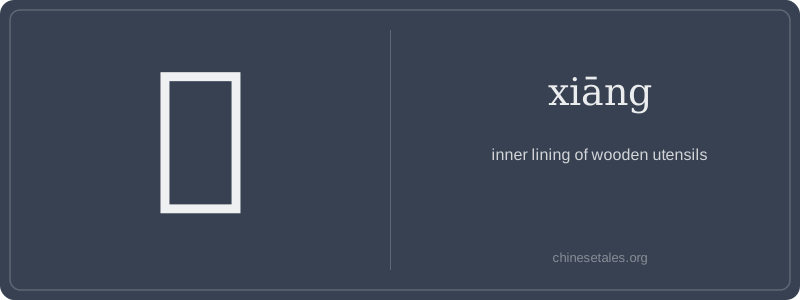
The earliest form of 欀 appears in bronze inscriptions of the Warring States period (475–221 BCE) as a compound pictograph: on the left, a simplified tree radical (木) indicating wood; on the right, a stylized depiction of concentric arcs — representing the hollowed-out interior of a vessel, with fine parallel lines suggesting planed, smooth grain. Over centuries, the right-hand component evolved from fluid curves into the rigid, angular structure we see today (襄), which originally conveyed 'to wrap around' or 'to enclose' — reinforcing the idea of an inner enclosure. By the Han dynasty, the character stabilized into its current form: 木 + 襄, where 襄 phonetically approximates xiāng while semantically reinforcing 'envelopment.'
This character’s meaning stayed remarkably stable across two millennia — always referring to the interior wooden surface, never drifting into metaphorical use (unlike 相 or 想). It appears in the *Rites of Zhou* (Zhou Li) describing lacquerware standards, and in Song-dynasty carpentry manuals specifying that 'the 欀 must be free of knots and evenly tapered.' Its visual design is literally architectural: the left side is the material (wood), the right side is the spatial concept (inner containment) — making it one of Chinese writing’s rare 'cross-section diagrams' turned into script.
Think of 欀 (xiāng) as the 'inner sleeve' of a wooden bowl — not the bowl itself, but the smooth, finished layer inside it, like the polished cedar lining of a traditional Japanese lacquer rice container. In Chinese, it’s a highly specialized noun referring exclusively to the interior surface or inner lining of wooden vessels (e.g., buckets, tubs, mortars), and it almost never appears outside classical texts, craft terminology, or regional woodworking glossaries. You’ll never hear it in daily conversation — even most native speakers haven’t encountered it since middle school classical readings.
Grammatically, 欀 functions only as a noun, often appearing after measure words like 一層 (yī céng, 'a layer') or paired with verbs like 削 (xuē, 'to plane/shave') or 磨 (mó, 'to polish'). For example: '這木臼的欀須用鹿角鏟細修' (zhè mù jiù de xiāng xū yòng lù jiǎo chǎn xì xiū) — 'The inner lining of this wooden mortar must be finely scraped with a deer-antler chisel.' Note: it never takes aspect particles (了, 過) or modifiers like adjectives — its usage is fossilized and technical.
Culturally, 欀 embodies a quiet reverence for material integrity: the quality of the inner surface determined food safety, grain storage longevity, and even ritual purity in ancient granaries. Learners often misread it as 相 (xiāng, 'mutual') or 想 (xiǎng, 'to think') due to identical pronunciation — but those characters are ubiquitous; 欀 is a linguistic antique, like finding a brass gear in a smartphone. Its near-total absence from modern media means encountering it feels like opening a carpenter’s secret notebook from the Han dynasty.