栌
Character Story & Explanation
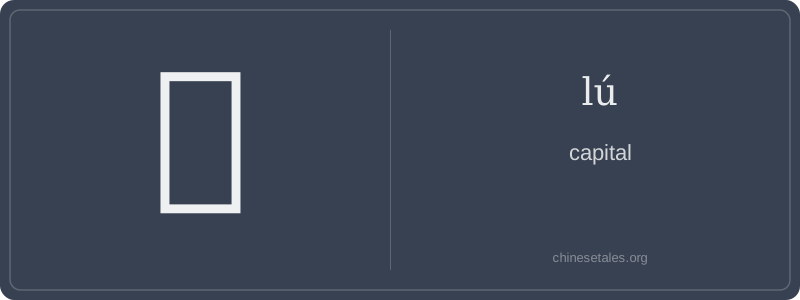
The earliest form of 栌 appears in Han dynasty stone carvings and late Warring States bronze inscriptions — not as a pictograph, but as a stylized composite: the left side 木 (mù, 'tree') anchors it in woodcraft, while the right side 卢 (lú) originally depicted a cooking vessel over fire (in oracle bone script 卢 was 卢 → 卥 + 尸), later simplified to signify sound. Over centuries, 卢 lost its fire-related meaning and became purely phonetic, while 木 insisted on materiality — making 栌 a classic xíngshēng (phono-semantic) character where 'wood' tells you what it *is*, and 'Lu' tells you how to say it.
By the Tang and Song dynasties, 栌 appeared in technical manuals like Yingzao Fashi (1103 CE), the world’s first state-published architectural code — where it’s defined precisely as the horizontal block connecting column to beam, crucial for cantilevered eaves. Poets like Du Fu used it metonymically: 'the crumbling 栌' signaled dynastic decline — not just decayed wood, but failing foundations of order. Its shape — compact, balanced, nine strokes — mirrors its function: small but indispensable, holding up more than itself.
At first glance, 栌 (lú) feels like a quiet relic — it means 'capital' in the architectural sense: the ornamental wooden block that sits atop a column’s top, distributing weight in traditional Chinese timber-frame buildings. Unlike English 'capital', which evokes cities or finance, 栌 is deeply tactile and structural — it’s about balance, precision, and silent support. You won’t hear it in daily conversation; it lives in architecture textbooks, classical poetry about palaces, and UNESCO restoration reports on Ming-dynasty temples.
Grammatically, 栌 is a noun, almost always appearing in compound terms (e.g., 斗栱 dǒu gǒng — bracket set). It rarely stands alone and never functions as a verb or adjective. Learners sometimes mistakenly treat it like a modern word — say, trying to say 'the capital of the province' with 栌 — but that’s wrong: use 首都 (shǒudū) for political capitals. Also, note its tone: lú (second tone), not lǔ or lù — mispronouncing it risks sounding like 'stewed' (卤 lǔ) or 'road' (路 lù).
Culturally, 栌 embodies a core Chinese value: strength through subtlety. This unassuming block bears immense load yet remains hidden beneath eaves and beams — a metaphor for humility in leadership or quiet competence. Modern architects still study 栌 systems to understand how pre-modern China built earthquake-resilient halls without nails. Mistake it for a generic 'head' character? You’ll miss the poetry of load-bearing grace.