橱
Character Story & Explanation
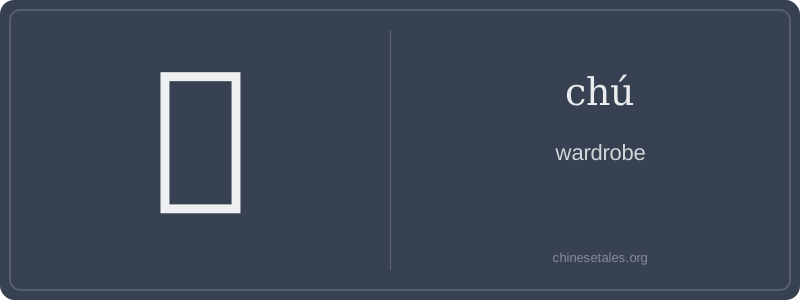
The earliest form of 橱 appears in seal script (around 221 BCE), where it combined 木 (wood) on the left with 廚 (chú, ‘kitchen’) on the right—yes, literally ‘wooden kitchen’. But this wasn’t about cooking! In ancient China, kitchens were often storage hubs for dry goods, and large wooden cabinets there evolved into general-purpose storage units. Over centuries, the right side simplified from 廚 to 菉 (a variant form), then further streamlined to 叔—though today’s standard form retains the phonetic hint: 叔 (shū) sounds nothing like chú, but historically, regional pronunciations aligned closely enough to serve as a rough sound cue.
By the Tang dynasty, 橱 had fully separated from kitchen-specific meaning and referred broadly to enclosed, tall, door-equipped wooden cabinets—especially for clothing. The classic 《长物志》 (Treatise on Superfluous Things, 1621) praises ‘elegant 橱 with rosewood frames and cloud-patterned ironwork’, revealing how deeply such objects were tied to literati values of restraint and refined utility. Visually, the 16 strokes map perfectly to craftsmanship: the 木 radical grounds it in nature; the upper 叔 hints at structure (its three horizontal strokes evoke shelves); and the lower 又 (‘again’)—now stylized—once suggested repeated opening/closing of doors.
At its heart, 橱 (chú) isn’t just a piece of furniture—it’s a quiet testament to how Chinese language anchors meaning in material reality. The character literally means ‘wardrobe’ or ‘cabinet’, but carries the subtle weight of order, containment, and domestic care: it’s where clothes are kept clean, folded, protected—never just dumped. Unlike English’s abstract ‘wardrobe’, which can also mean ‘a collection of roles’ (e.g., ‘his acting wardrobe’), 橱 stays stubbornly physical and wooden—no metaphors allowed without explicit context.
Grammatically, 橱 is a noun that rarely stands alone; it almost always appears in compounds (like 衣橱 or 厨柜) or with measure words: 一个橱 (yí gè chú), 两扇橱门 (liǎng shàn chú mén). Learners often mistakenly use it like a verb (‘to cupboard’) or confuse it with 储 (chǔ, ‘to store’)—but 橱 never verbs itself. It’s a container, not an action. You don’t ‘橱 something’—you ‘put something in the 橱’ (放进橱里).
Culturally, 橱 reflects traditional Chinese home aesthetics: functional elegance, wood as virtue (hence the 木 radical), and quiet dignity in daily objects. Older homes featured hand-carved 橱 with brass fittings—symbols of family stability. A common learner pitfall? Using 橱 when they mean ‘kitchen cabinet’ (which is usually 橱柜 or 厨柜)—or worse, mixing it up with 厨 (chú, ‘kitchen’), leading to hilariously off-target sentences like ‘I sleep in the kitchen’ instead of ‘I put my coat in the wardrobe’.