栉
Character Story & Explanation
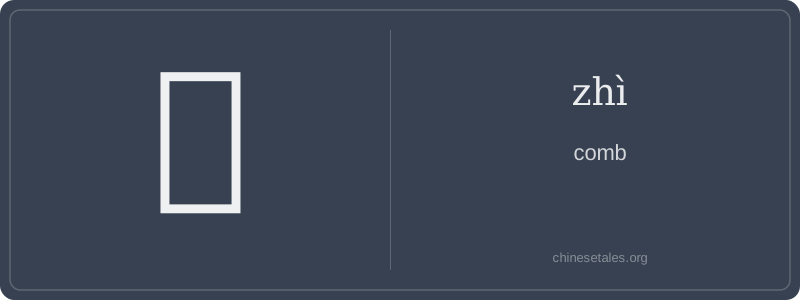
The earliest form of 栉 appears on Warring States bamboo slips — not as a pictograph of a comb per se, but as a stylized representation: two parallel vertical strokes (the teeth) suspended between two horizontal bars (the frame), all enclosed within a wooden handle shape. Over centuries, the top bar evolved into the 竹 (bamboo) radical — reflecting that many elite combs were actually made of bamboo — while the lower part simplified into 節, preserving the idea of 'segmented teeth'. By the Han dynasty seal script, the wood radical (木) replaced 竹 at the bottom, emphasizing material over structure — a subtle but telling shift toward function and origin.
This character’s semantic journey mirrors China’s evolving aesthetics: from practical Shang dynasty bone combs used in divination rituals, to ornate Han jade combs buried with nobles as symbols of purity and order, to Tang poets using 栉 metaphorically — Li Bai wrote of 'combing the clouds' (栉云) to describe soaring ambition. Its presence in the phrase 栉风沐雨, cited in the Book of Rites, cemented its role as a verb of dignified endurance. Even today, calligraphers choose 栉 over 梳 when inscribing scrolls about perseverance — because every stroke must be deliberate, just like each tooth of the comb.
At its heart, 栉 (zhì) is a quiet artisan of order — not just a tool for taming hair, but a symbol of meticulous care and ritual precision. Its wood radical (木) tells us it’s made of wood (true for ancient combs), while the right side, 節 (jié, 'joint' or 'node'), hints at the fine, parallel teeth that 'joint' together to separate strands. Unlike common verbs like 梳 (shū), which means 'to comb' and appears in daily speech, 栉 is literary, formal, or poetic — you’ll find it in classical idioms, historical texts, or refined expressions like 栉风沐雨 ('comb wind, bathe in rain': enduring hardship with grace). It almost never appears alone as a verb in modern spoken Chinese; instead, it thrives in compounds or fixed phrases.
Grammatically, 栉 functions mostly as a verb in literary contexts (e.g., 栉发 — 'to comb one’s hair', evoking elegance or preparation), or as a noun meaning 'comb' — but only in archaic or stylistically elevated registers. Learners often mistakenly use it like 梳 in casual speech ('I’ll comb my hair' → *我栉头发), which sounds jarringly antique or even comical. It’s also easily misread as 節 (jié) due to visual similarity — but while 節 means 'node' or 'festival', 栉 is strictly about combing action or the object itself.
Culturally, 栉 carries Confucian undertones: grooming wasn’t vanity but self-cultivation. The Classic of Filial Piety mentions caring for parents’ hair with reverence — a duty expressed through verbs like 栉. Its rarity today makes it a linguistic time capsule: encountering it feels like opening a lacquered box from the Han dynasty. And yes — it’s pronounced zhì, rhyming with 'cheetah', not 'zhi' like 'zhi' in 'zhi hu zhe ye'. That tone shift trips up even advanced learners!