槛
Character Story & Explanation
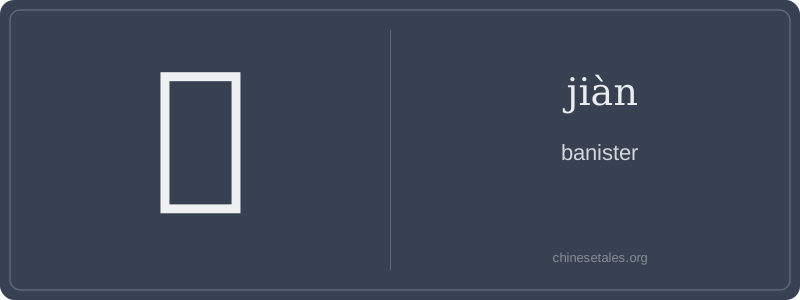
The earliest form of 槛 appears in bronze inscriptions as a pictograph showing a raised wooden platform with two parallel horizontal beams — one at knee-height, one at waist-height — flanked by vertical posts. The top beam was often stylized as a square enclosure (口), while the lower structure evolved into 兼, which originally depicted two hands holding two stalks of grain, symbolizing 'holding both sides together'. Over centuries, the oracle bone simplicity gave way to seal script’s balanced symmetry, then clerical script’s flattened strokes — until the modern form solidified: 木 on the left anchoring the meaning (wood), and 口 + 兼 on the right encoding the function (a framed, dual-level barrier).
By the Han dynasty, 槛 appeared in Sima Qian’s *Records of the Grand Historian*, describing palace balustrades where officials stood awaiting imperial summons — not merely functional, but symbolic of rank and access. In Tang poetry, Du Fu wrote of leaning on the ‘window’s 槛’ while mourning lost glory, turning the railing into a silent witness. Its shape never changed much, but its emotional weight deepened: a wooden threshold between freedom and confinement, beauty and sorrow — all held in fourteen deliberate strokes.
Think of 槛 (jiàn) not as just a 'banister' but as the elegant, wooden boundary between safety and spectacle — originally the ornate railing around a raised platform or stage in ancient courts, later evolving into the decorative railings of pavilions, balconies, and even prison cages. It’s deeply visual: the 木 (wood) radical tells you it’s made of timber, while the 口 (mouth/enclosure) + 兼 (to hold both sides) component hints at its function — a horizontal bar that 'holds together' or 'frames' a space. This isn’t a casual handrail; it’s architectural punctuation with gravitas.
Grammatically, 槛 is almost always a noun and appears in formal or literary contexts — never in everyday spoken phrases like 'hold the railing'. You’ll see it in compound words (e.g., 门槛, 窗槛), rarely alone. Learners often misread it as 'kǎn' (like 门槛), but here it’s *always* jiàn — except in one fossilized term: 槛车 (kǎn chē), an ancient prison cart with barred enclosures. Yes — the same character shifts pronunciation based on historical function!
Culturally, 槛 carries quiet tension: it separates observer from observed — think of poets leaning on a balcony railing (栏杆) to gaze at falling leaves, or prisoners gripping iron bars (囚槛). Mistake it for 间 (jiān, 'interval') or 俭 (jiǎn, 'frugal'), and your sentence collapses entirely. And no — it’s *not* used for modern stair railings; those are 栏杆 (lángān). Reserve 槛 for classical architecture, poetry, or historical texts — where every stroke feels like carved lacquer.