檨
Character Story & Explanation
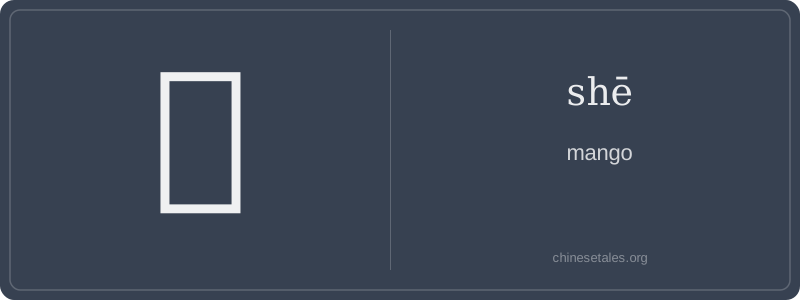
The character 檨 has no oracle bone or bronze script ancestry — it’s a latecomer, invented during the Ming or Qing dynasties to write the Southern Min word for mango, which arrived in Fujian and Taiwan via Portuguese traders (‘manga’ → Hokkien *suāi*). Its form is deliberately constructed: left side 木 (mù, ‘tree’) signals ‘wood/fruit-bearing plant’, right side 申 (shēn) serves purely as a phonetic hint — approximating the Hokkien *suāi* (later adapted to Mandarin *shē*). Visually, it’s a classic形声字 (xíngshēngzì, phono-semantic compound): the radical grounds it botanically, the phonetic anchors it acoustically — even if imperfectly.
Historically, 檨 never appeared in classical texts; mangoes weren’t cultivated in China until the 16th century. Its first documented use is in Qing-era local gazetteers from Taiwan, where it labeled orchards and tribute fruits. Interestingly, the right component 申 also means ‘to extend’ or ‘to declare’ — a poetic coincidence, since this character literally ‘declares’ the mango’s presence in Sinitic writing. Unlike native fruit characters like 桃 (táo, ‘peach’) — which evolved pictorially from tree + fruit — 檨’s origin is administrative and adaptive: a bureaucratic solution to naming an exotic import.
At first glance, 檨 (shē) looks like a rare botanical oddity — and it is! This character isn’t part of standard Mandarin’s core lexicon; it’s a regional lexical fossil, preserved almost exclusively in Southern Min (Hokkien/Taiwanese) speech and writing. In Mandarin, ‘mango’ is almost always 芒果 (mángguǒ), a transparent compound meaning ‘mangosteen-fruit’ (though mangosteen is actually 山竹). 檨, by contrast, is a phonetic loan — it borrows the sound *shē* (from Hokkien *suāi*) and grafts it onto a wood radical (木) to signal ‘tree fruit’. It feels less like a botanical term and more like linguistic archaeology: a character that doesn’t describe the fruit, but *honors the dialect that named it*.
Grammatically, 檨 behaves like any noun — subject, object, or modifier — but appears almost never in formal mainland texts or exams (hence its HSK absence). You’ll spot it on Taiwanese fruit stalls, in Min-speaking households, or in nostalgic food writing: ‘檨仔冰’ (shē zǎi bīng, mango ice), ‘青檨’ (qīng shē, green unripe mango). Crucially, it’s never used alone in Mandarin without context — saying just ‘檨’ sounds incomplete or dialectal to most Mandarin ears; you’d say ‘檨子’ (shē zi) or ‘檨仔’ (shē zǎi) for naturalness.
Culturally, this character reveals how Chinese writing absorbs linguistic diversity — not by erasing dialects, but by giving them visible space on the page. Learners often misread it as ‘shēn’ (like 申) or confuse it with 森 (sēn, ‘forest’), missing its regional soul. The biggest trap? Assuming it’s interchangeable with 芒果 — it’s not. Using 檨 in Beijing might earn you a polite, puzzled smile; in Tainan, it’s warm familiarity.